|
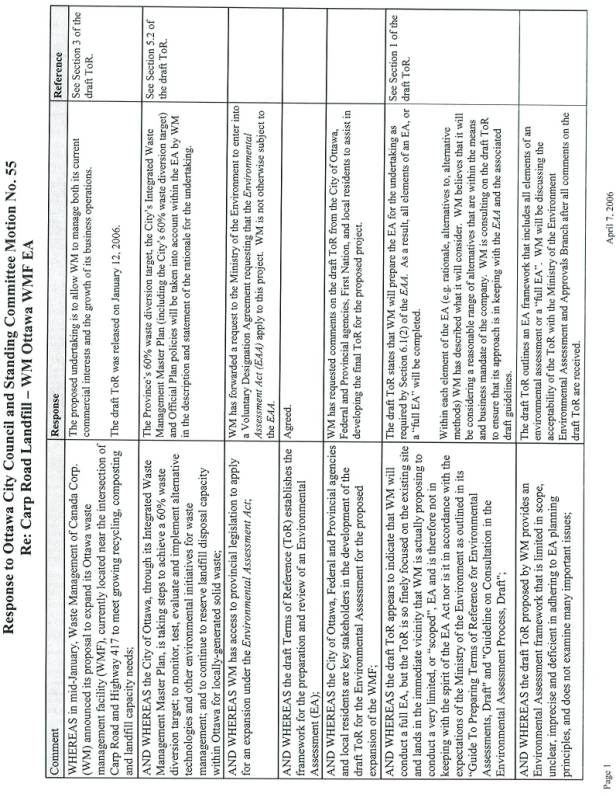
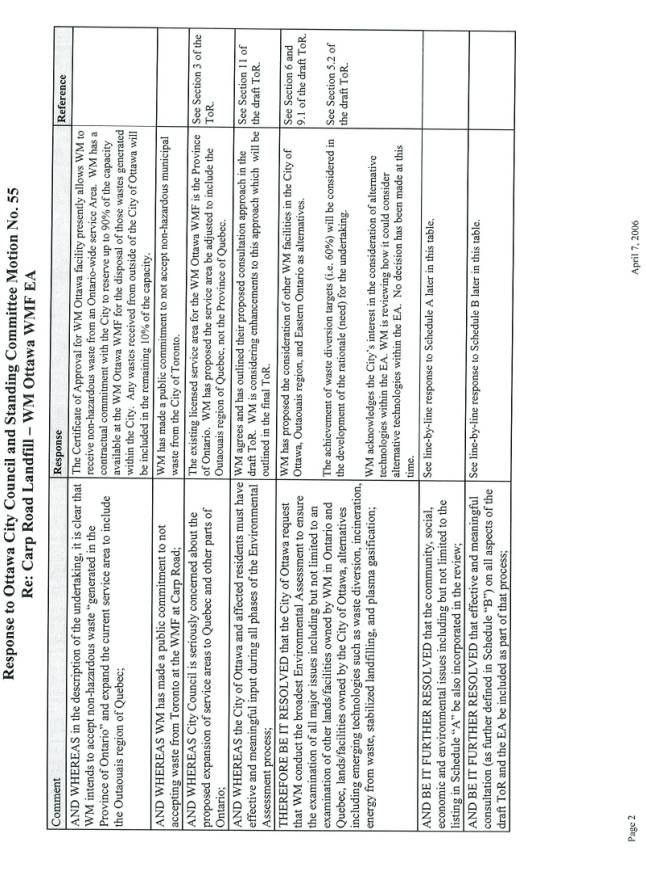
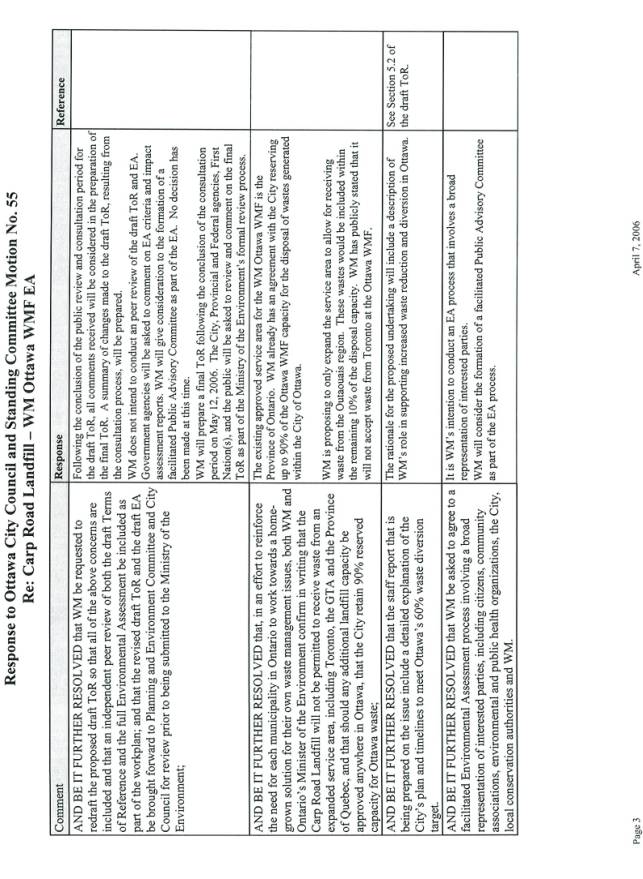
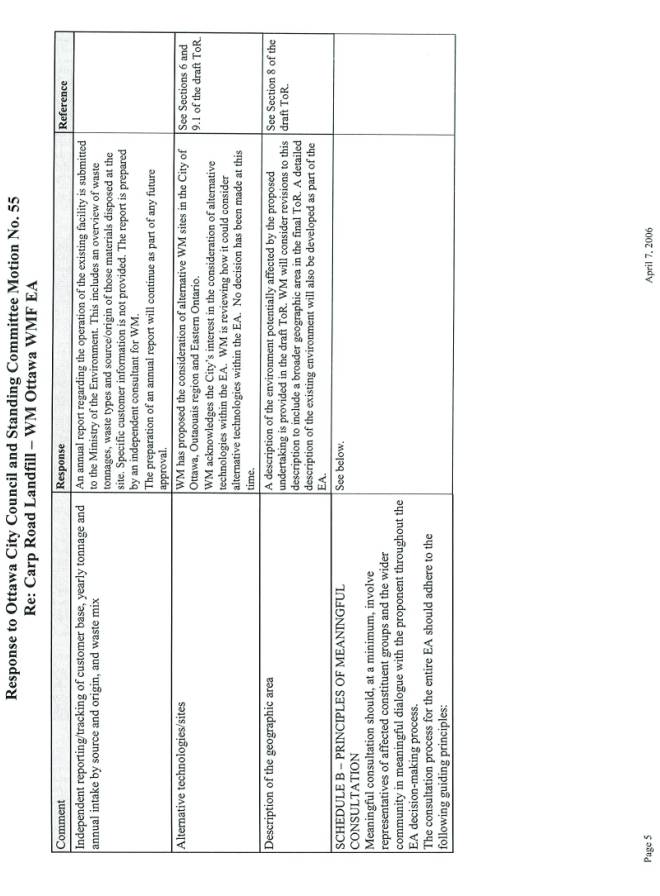
4. Comments on
Environmental Assessment (EA) Draft
Terms of Reference released by Waste Management of Canada Corporation for the
Carp Road Waste Management Facility
commentaires sur le cadre de référence préliminaire
de l'évaluation environnementale (EE)
publié par Waste Management
of Canada Corporation pour l'installation de gestion des déchets du chemin
Carp
|
Committee recommendations as
amended
That Council
endorse the comments contained in Attachment 1 as the City’s comments on Waste
Management of Canada Corporation’s Environmental Assessment Draft Terms of
Reference for the Carp Road Waste Management Facility, and direct staff to
forward them to the Ministry of the Environment and Waste Management of Canada
Corporation for consideration, and;
That
Council approve Motions 1 through 6 as recommended by the Planning and
Environment Committee on 23 May 2006, as follows:
Motion 1
WHEREAS, the record of compliance with environmental
law of any proponent that seeks a new or amended Certificate of Approval must
come before the Minister for consideration;
AND WHEREAS, consideration of the environmental
record of a proponent will both encourage compliance with environmental law in
this province and ensure that the risk to our environment is minimized by
removing from the industry companies with a history of violations;
AND WHEREAS, companies that operate waste disposal
facilities have a responsibility to the people living nearby, to the
environment, and to the generations that will inhabit the local environment in
the future;
AND WHEREAS the Ontario Protocol for Updating
Certificates of Approval for Waste Management Protocol Guidance and Direction issued by Ministry
of the Environment in January 2005, helps guide the Minister in her decision,
gives assistance to proponents and opponents alike in understanding the kind of
information the Minister will consider, and provides a mechanism by which
existing Certificates of Approval may be re-evaluated;
AND WHEREAS, the Ministry may review an existing
Certificate of Approval when an owner makes an application to the Ministry for
a change to the existing equipment, processes, production rates or for an
expansion of plant capacity (excluding applications for minor changes and
administrative amendments);
AND WHEREAS, the City seeks the express assurance of
the Ministry of the Environment as to the compliance obligations incumbent upon
the proponent and status thereof for the operation of the waste management
facility on Carp Road;
THEREFORE BE IT RESOLVED that Council
request that the Minster of the Environment:
1. Provide a complete copy of Waste Management of Canada
Corporation’s (WM) Carp Road waste management facility’s Certificate of
Approval, and any other related provincial, municipal or federal permits,
approvals and/or agreements, to the City and be placed on the public record for
review; and,
2. Provide
all regulatory compliance reports and complaint/response records for the Carp
Road waste management facility, submitted by the proponent, WM to the MOE for
the last 10 years of operation, and;
3. Hold in abeyance any
further review of the draft Terms of Reference until the regulatory compliance
status of the Carp Road site and operations of WM is confirmed, and;
4.
BE IT FURTHER RESOLVED that
Council circulate this motion to the Premier of Ontario, the Minister of the
Environment, all Ottawa area M.P.P.’s, the Association of Municipalities of
Ontario and the appropriate staff at the Ministry of the Environment.
Motion 2
WHEREAS, the draft Terms of Reference document, required as the first step to
complete a full individual EA, is generally deficient as to the purpose,
rationale and alternatives to the landfill expansion proposal;
AND WHEREAS, this document needs to be extensively revised to provide clarity as to
the proposal, the plans for evaluation of alternatives and alternative methods
and ensure that a commitment to an overall EA monitoring strategy is
undertaken;
AND WHEREAS, Waste
Management of Canada Corporation (WM) must give key stakeholders sufficient
detail of its proposed EA, so that these stakeholders can give more than just pro
forma input, and are not left to speculate as to what WM may or may not do;
AND WHEREAS, based on the
current document, the City’s assessment is that WM
has not met the requirements of the EA guidelines and that an EA conducted in
accordance with the draft ToR document will likely lead to an environmentally
unsound proposal;
AND WHEREAS, the
west end community of Ottawa is profoundly concerned that its health and
well-being, and will be, adversely affected by this Landfill and any proposed
expansion thereof;
AND WHEREAS,
approximately 10,000 people have signed the petition in opposition to the
Landfill expansion drafted by MPP Sterling, and presented to the Legislature by
MPPs Sterling and MacLeod and based on statements of the Minister of
Environment in the Legislature, each signature on this petition in opposition
to the Landfill expansion will be considered a separate comment;
THEREFORE BE IT RESOLVED
that Council:
1. Request the Minister
of Environment allow the City and the public to present
further submissions in response to any amended ToR proposal by WM that may be
filed in the future to MOE, and that the City and the public be given no less
than 180 days to respond to any such amended proposal, and;
2. Request the Minister
of the Environment to require any EA conducted by WM be peer reviewed by
independent experts paid for by WM and that the review be supervised by the City of Ottawa, and;
3.
BE IT FURTHER RESOLVED that Council circulate this motion to the
Premier of Ontario, the Minister of the Environment, all Ottawa area M.P.P.’s,
the Association of Municipalities of Ontario and the appropriate staff at the
Ministry of the Environment.
Motion 3
WHEREAS,
in mid-January, Waste Management Corporation of Canada (WM) announced its
proposal to expand its Carp Road landfill from 8 to 26 million cubic
metres in 25 years - a three-fold increase in size;
AND
WHEREAS, during the period for public comment, sharing information, resources, and expertise, four representative
community groups recently submitted one joint set of comments on the draft
Terms of Reference to WM, titled Response
of the Community including a separate set of comments by OttawaLandfillWatch.org,
titled Alternatives to Landfill for Waste
Disposal in the City of Ottawa;
AND WHEREAS, accompanying the joint submission was a
separate report by the Stittsville Village
Association (SVA), titled Comments on the
Draft Environmental Assessment Terms of Reference;
AND WHEREAS, these documents have been
endorsed by all four community groups and are the culmination of an unprecedented effort by hundreds of volunteers
and the result of thousands of volunteer hours and includes the discussion group
reports from the March 28th Community Action Forum convened by Councillors
Feltmate, El-Chantiry and Stavinga and benefits from a legal review;
AND WHEREAS, these reports include over 250 recommendations and
thousands of individual comments that must be addressed prior to the formal
submission and approval of WM’s Terms of Reference;
AND WHEREAS, among the concerns raised are the existing conditions and operations of WM’s
facility, justification of the need for additional disposal capacity, and the
long-term sustainability of such an expansive undertaking;
AND WHEREAS, these reports also draw attention to the disparity between
the provincial target for landfill diversion and the absence of effective
policies and regulations for managing industrial, commercial and institutional
(ICI) waste and note that over 60% of the waste entering WM’s facility is ICI;
THEREFORE BE IT RESOLVED that Council:
1. Request the Minister of Environment to consider the full
public record compiled as a result of the draft Terms of Reference and advise the City of actions to be undertaken in conjunction with its
review of the Terms of Reference, and;
2. Circulate this motion to the Premier
of Ontario, the Minister of the Environment, all Ottawa area M.P.P.’s, the
Association of Municipalities of Ontario and the appropriate staff at the
Ministry of the Environment.
Motion 4
WHEREAS,
the City delivers a broad spectrum of residential solid waste services
including the collection and disposal of municipal solid waste and the diversion
of materials from landfill;
AND
WHEREAS, in 2005, this resulted in the collection of 319,500 tonnes of
residential waste, of which 108,949 tonnes, or 34%, was diverted from disposal;
AND
WHEREAS, based on limited information collected from private waste collection
and landfill contractors, over twice as much solid waste was collected from the
industrial, commercial and institutional (ICI) sector, with only 17.5% of that
diverted from landfill and these services are provided to local businesses,
employers and service providers through the work of a number of private
contractors;
AND
WHEREAS, although the City is not responsible for the ICI waste collection,
diversion and disposal services, Council’s recent decision to offer waste
collection and diversion service to the small business community through the
Yellow Bag program, is an initial step towards minimizing landfill requirements
for this sector;
AND
WHEREAS, in accordance with the City’s Integrated Waste Management Master Plan
continued efforts are underway to develop initiatives to maximize waste
diversion and minimize landfill capacity consumption including Residential
Waste Diversion Strategy and Education and Communication Programs;
AND
WHEREAS, the City will be undertaking a review of new and emerging technologies
through a Request
for Expression of Interest (REOI) to be issued in June 2006 with a summary
review of this Alternative Technologies REIO expected to be before Committee in
the Fall of 2006;
AND WHEREAS, efforts are also underway
to review the adequacy of the Waste Characterization study completed in 2000
for the residential and ICI sectors;
AND WHEREAS, this review will assist
the City in potential selection of alternative technologies and as such,
financial and staffing requirements that are to be identified as part of the
2007 Budget process;
THEREFORE BE IT RESOLVED that Council:
1. Direct
that the REOI to be undertaken include a thorough examination of the suite of
technologies for managing both residential and ICI waste streams.
2. Revisit its Integrated Waste
Management Master Plan (IWMMP) to develop comprehensive city wide residential
and ICI waste management strategies, and;
a) That
this undertaking examine such matters as the management of ICI waste, municipally-operated
alternatives competing with, or replacing, privately operated landfills for
both residential and ICI waste, regulatory requirements, recycling programs,
diversion measures, alternative disposal solutions, waste-to-energy systems,
and environmentally-sustainable landfills, as well as the implementation of a
process to ensure the Plan is regularly updated to include new insights
garnered from initiatives piloted/implemented by other municipalities in
Ontario and elsewhere; and
b) That this undertaking be conducted
expeditiously with funds to be made available in 2006 from the Solid Waste
Compensation Reserve Fund; and,
3. Formally
request Waste Management to give due consideration to the ongoing efforts of
the City to address its waste management needs.
4. Formally
request Waste Services Inc., who are concurrently preparing draft terms of
reference for an environmental assessment to increase the capacity of its Navan
Road landfill, give due consideration to the ongoing efforts of the City to
address its waste management needs, and;
5. Circulate
this motion to the Premier of Ontario, the Minister of the Environment, all
Ottawa area M.P.P.’s, the Association of Municipalities of Ontario and the
appropriate staff at the Ministry of the Environment.
Motion 5
WHEREAS, recognizing a
looming waste management problem, Ontario governments in the late 1980s and in
early 1990s introduced a variety of policies, regulations and funding programs
to introduce, then develop and enhance waste diversion, including the Waste
Diversion Act, 2002;
AND WHEREAS, in June 2004,
the MOE released a Discussion Paper and conducted public consultation sessions
on how to achieve the Provincial-wide goal of 60% waste diversion with
extensive discussions on several key topics, such as accelerating centralized
composting for residential waste and the feasibility of phasing-in a ban on
disposal of key organics and recyclable materials; renewing commitment on
institutional, commercial and industrial (ICI) waste diversion; reducing
packaging and increasing the recycled content in products and packaging;
finding new waste diversion technologies; and initiating a Province wide
monitoring system for waste;
AND WHEREAS, despite these
efforts, Provincial leadership has diminished in recent years, to the extent
that in January 2005 the Ontario Waste Management Association submitted a
report entitled “The Private Sector ICI and Waste Management System in Ontario”
and in December 2005, the Association of Municipalities of Ontario submitted a
“Proposal for a Provincial Integrated Waste Management Strategy”;
AND WHEREAS, the Province
has the authority and regulatory ability to directly impact diversion rates and
lower the reliance on landfills and has not taken any concrete action directing
the ICI sector to achieve the 60% diversion goal;
THEREFORE BE IT RESOLVED
that Council approve:
1. That City staff
expedite the review of existing regulatory involvement, monitoring, diversion
and service delivery opportunities and mandates to encourage diversion efforts
with the local ICI sector and report back to Planning and Environment Committee
in Winter 2006/2007.
2. That the Province be
requested to increase enforcement of existing regulations such as Waste Audits
and Waste Reduction Work Plans (O. Reg 102/94) and Industrial, Commercial and
Institutional (ICI) Source Separation Programs (O. Reg. 103/94).
3. That the Province be
requested to establish a Task Force involving appropriate stakeholders,
including municipal representatives from Association of Municipalities of
Ontario, LUMCO, Rural Ontario Municipalities Association and representatives
from ICI sectors, Ontario Waste Management Association, Recycling Council of
Ontario and others to formulate integrated waste management strategies for
areas within the Province of Ontario, and;
4. That this motion be
circulated to the Premier of Ontario, Minister of the Environment, all Ottawa
area M.P.P.’s, the Association of Municipalities of Ontario, the Large Urban
Mayors’ Council of Ontario (LUMCO), the Rural Ontario Municipalities
Association (ROMA), the Ontario Waste Management Association (OWMA) and the
Recycling Council of Ontario (RCO)
MOTION 6
WHEREAS
limitations of existing landfill capacity and the social, economic and
environmental costs of expanding landfill is forcing the City of Ottawa and its
citizens to rethink waste collection and disposal strategies;
WHEREAS
waste diversion is the most fundamental solution to reducing waste disposal;
WHEREAS
the Province of Ontario has set a 60% waste diversion target to be achieved by
2008;
WHEREAS
in the residential MSW sector the City of Ottawa will achieve this target by
2008;
WHEREAS
there does not appear to be a waste diversion strategy to achieve this
provincial target in the ICI sector;
THEREFORE
BE IT RESOLVED that Council:
1. Direct
that the City of Ottawa as an institution become a model for waste diversion
for the ICI sector by developing waste diversion programs (including recycling)
for its offices, buildings and public facilities;
2. Direct
that such proposals to begin implementing these programs be developed for the
2007 budget, with final implementation being achieved by the 2008 budget;
3. Formally
request Waste Management to give due consideration to the ongoing efforts of
the City to address its waste management needs;
4. Formally
request Waste Services Inc., who are concurrently preparing draft terms of
reference for an environmental assessment to increase the capacity of its Navan
Road landfill, give due consideration to the ongoing effort of the City to
address its waste management needs;
5. Circulate
this motion to the Premier of Ontario, Minister of the Environment, all Ottawa
area M.P.P.’s, the Association of Municipalities of Ontario and the appropriate
staff at the Ministry of the Environment.
Recommandations modifiÉes du Comité
Que le
Conseil municipal considère les commentaires inclus dans l’annexe 1 comme les
commentaires de la Ville sur le cadre de référence préliminaire de l’évaluation
environnementale faite par l’entreprise Waste Management of Canada pour
l’installation de gestion des déchets du chemin Carp et ordonner au personnel
de les acheminer au ministère de l’Environnement et à l’entreprise Waste
Management of Canada pour qu’ils les étudient, et;
Que le
Conseil approuve les Motions numérotées de 1 à 6 telles que recommandées par le
Comité de l’urbanisme et de l’environnement le 23 mai 2006 et qui
suivent :
MOTION 1
ATTENDU QUE le dossier en matière de
respect des lois environnementales de tout promoteur cherchant à obtenir ou à
faire renouveler un certificat d’approbation doit être soumis à l’examen du
Ministre;
ATTENDU QUE l’examen du dossier
environnemental des promoteurs favorisera le respect des lois environnementales
dans la province et permettra de minimiser les risques pour l’environnement en
assurant le retrait de ce secteur d’activité des entreprises ayant violé les
lois environnementales à diverses reprises;
ATTENDU QUE les entreprises qui
exploitent des installations d’élimination des déchets ont des responsabilités
à l’égard des personnes qui vivent à proximité de ces installations, de
l’environnement et des générations qui habiteront l’environnement local dans
l’avenir;
ATTENDU QUE le Protocole ontarien
pour la mise à jour des certificats d’approbation pour la gestion des déchets,
que le ministère de l’Environnement a rendu public en janvier 2005, facilite la
décision de la Ministre, aide les promoteurs autant que les adversaires à
comprendre le genre de renseignements que la Ministre prendra en considération
et constitue un mécanisme de réévaluation des certificats d’approbation
existants;
ATTENDU QUE le Ministère peut
réexaminer un certificat d’approbation existant lorsqu’un propriétaire lui
demande d’apporter un changement à l’équipement, aux procédés et aux rythmes de
production existants ou souhaite faire approuver l’agrandissement de la
capacité d’une installation (exception faite des demandes portant sur des
modifications mineures ou de nature administrative);
ATTENDU QUE la Ville cherche à
obtenir une assurance expresse du Ministère en ce qui concerne les obligations
qui incombent au promoteur et à son statut par rapport à l’exploitation de
l’installation de gestion des déchets du chemin Carp;
IL EST RÉSOLU que le
Conseil demande à la ministre de l’Environnement :
1.
De fournir à la Ville et de rendre publics la version
complète du certificat d’approbation délivré à la société Waste Management of Canada
Corporation (WM) pour l’installation de gestion des déchets du chemin Carp
ainsi que les approbations, ententes et permis fédéraux, provinciaux et
municipaux connexes;
2.
De produire tous les rapports de conformité
réglementaires ainsi que les dossiers de plainte relatifs à l’installations de
gestion des déchets du chemin Carp soumis par le promoteur (Waste Management)
au ministère de l’Environnement relativement aux 10 dernières années
d’exploitation;
3.
De suspendre tout nouvel examen du cadre de référence jusqu’à ce que le
statut de l’installation du chemin et de la société Waste Management en matière
de conformité à la réglementation ait été confirmé;
4.
De porter la présente résolution à la connaissance du premier ministre
et de la ministre de l’Environnement de l’Ontario, des députés provinciaux de
la région d’Ottawa, de l’Association des municipalités de l’Ontario et du
personnel compétent du ministère de l’Environnement de l’Ontario.
MOTION 2
ATTENDU QUE le projet de cadre de
référence, première étape d’une évaluation environnementale distincte, comporte
des lacunes sur le plan des objectifs, de la raison d’être et des solutions de
rechange à la proposition d’agrandissement de la décharge;
ATTENDU QUE le présent document doit
faire l’objet d’une révision en profondeur afin d’assurer la clarté de la
proposition et des plans d’évaluation des solutions et méthodes de rechange
ainsi que la prise d’un engagement envers la stratégie globale de contrôle de
l’évaluation environnementale;
ATTENDU QUE la société Waste
Management of Canada Corporation (WM) doit fournir aux principaux intervenants
suffisamment de renseignements au sujet de son projet d’évaluation
environnementale pour que ces derniers puissent formuler des commentaires
étayés et qu’ils n’en soient pas réduits à spéculer sur les projets de
l’entreprise;
ATTENDU QUE, se fondant sur le
document actuel, la Ville estime que la société Waste Management n’a pas rempli
les exigences des lignes directrices sur l’évaluation environnementale et
qu’une évaluation environnementale réalisée conformément au projet de cadre de
référence aboutira probablement à une proposition qui ne sera pas valable d’un
point de vue environnemental;
ATTENDU QUE la collectivité de
l’Ouest de la ville craint sérieusement que cette décharge et son éventuel
agrandissement aient des conséquences négatives sur sa santé et son bien-être;
ATTENDU QU’environ 10 000
personnes ont signé, afin d’exprimer leur opposition à l’agrandissement de la
décharge, une pétition rédigée par le député provincial Sterling, que celui-ci
a déposé à l’Assemblée législative avec la députée MacLeod, et que, selon les
déclarations faites par la ministre de l’Environnement à l’Assemblée
législative, chacune des signatures figurant sur cette pétition sera considérée
comme un commentaire distinct;
1.
Demande à la ministre de l’Environnement de permettre
à la Ville et à la population de présenter d’autres mémoires si la société
Waste Management soumet un cadre de référence modifié au ministère de
l’Environnement, et que la Ville et la population devront avoir au moins 180
jours pour répondre à une éventuelle proposition modifiée;
2.
Demande à la ministre de l’Environnement d’exiger que
toute évaluation environnementale menée par la société Waste Management fasse
l’objet d’un examen par des spécialistes indépendants sous la supervision de la
Ville d’Ottawa;
3.
Porte
la présente résolution à la connaissance du premier ministre et de la ministre
de l’Environnement de l’Ontario, des députés provinciaux de la région d’Ottawa,
de l’Association des municipalités de l’Ontario et du personnel compétent du
ministère de l’Environnement de l’Ontario.
MOTION 3
ATTENDU
QUE, à la mi-janvier, la société Waste Management Corporation of Canada (WM) a
fait connaître sa proposition visant à porter la capacité de la décharge du
chemin Carp de 8 à 26 millions de mètres cubes en 25 ans, soit trois fois sa capacité
actuelle;
ATTENDU
QUE, durant la période réservée aux commentaires de la population et au partage
de renseignements, de ressources et d’expertise, quatre groupes communautaires
représentatifs ont soumis conjointement à la société Waste Management un
ensemble de commentaires, sous le titre Response
of the Community (Réponse de la
collectivité), y compris un ensemble de commentaires distincts soumis par
l’organisme OttawaLandfillWatch.org sous le titre Alternatives to Landfill for Waste Disposal in the City of Ottawa (Solutions
de rechange aux décharges pour l’élimination des déchets à Ottawa);
ATTENDU QUE les
commentaires conjoints s’accompagnaient d’un rapport distinct de la Stittsville
Village Association (SVA) intitulé Comments on the Draft Environmental
Assessment Terms of Reference (Commentaires sur le projet de cadre de
référence pour l’évaluation environnementale);
ATTENDU
QUE les quatre organismes communautaires souscrivent à ces documents, qui
constituent l’aboutissement d’un effort sans précédent de la part de centaines
de bénévoles et le résultat de milliers d’heures de bénévolat; qui tiennent
compte des rapports de groupes de discussion consécutifs au Forum d’action
communautaire du 28 mars convoqué par les conseillers Feltmate, El-Chantiry et Stavinga,
et qu’ils ont fait l’objet d’un examen juridique;
ATTENDU QUE ces rapports renferment
plus de 250 recommandations ainsi que les commentaires de milliers de
personnes, dont il faut tenir compte avant la présentation et l’approbation
officielles du cadre de référence de la société Waste Management;
ATTENDU QUE les préoccupations
concernent notamment l’état et l’exploitation actuels de l’installation de la
société Waste Management, la justification invoquée pour l’agrandissement et la
viabilité d’une opération aussi coûteuse;
ATTENDU QUE ces rapports font
également ressortir la disparité qui existe entre l’objectif provincial de
ré-acheminement des déchets et l’absence de politique et de règlement efficaces
pour la gestion des déchets industriels, commerciaux et institutionnels (ICI),
tout en soulignant le fait que plus de 60 p. 100 des déchets déversés à
l’installation de la société Waste Management sont des déchets industriels,
commerciaux et institutionnels;
IL
EST RÉSOLU que le Conseil :
1. Demande
à la ministre de l’Environnement de tenir compte de l’ensemble du dossier
public constitué à la suite de la publication du projet de cadre de référence
et de faire part à la Ville des mesures devant être prises simultanément à
l’examen du cadre de référence.
2.
Porte la présente résolution à la connaissance du premier ministre et de la
ministre de l’Environnement de l’Ontario, des députés provinciaux de la région
d’Ottawa, de l’Association des municipalités de l’Ontario et du personnel
compétent du ministère de l’Environnement de l’Ontario.
MOTION 4
ATTENDU QUE la Ville fournit un
large éventail de services liés aux déchets solides résidentiels, notamment des
services de collecte et d’élimination des déchets solides municipaux et le
ré-acheminement de matières qui autrement seraient déversées dans les décharges
municipales;
ATTENDU QUE, en 2005, ce service
s’est traduit par la collecte de 319 500 tonnes de déchets résidentiels,
dont 108,949 tonnes, soit 34 p. 100, ont été ré-acheminées;
ATTENDU QUE, selon l’information
limitée obtenue des entrepreneurs privés qui assurent la collecte de déchets et
l’exploitation de décharges, plus du double de déchets solides ont été
recueillis auprès du secteur industriel, commercial et institutionnel (ICI),
dont seulement 17,5 p. 100 ont été ré-acheminés, et que ces services
sont fournis aux entreprises, employeurs et fournisseurs de services locaux par
un certain nombre d’entrepreneurs privés;
ATTENDU QUE, malgré le fait que la
Ville n’est pas responsable des services de collecte, de ré-acheminement et
d’élimination des déchets provenant du secteur ICI, la récente décision du
Conseil d’offrir des services de collecte et de ré-acheminement des déchets aux
petites entreprises dans le cadre du Programme des sacs jaunes constitue un
premier pas vers la réduction de la nécessité d’utiliser les décharges pour ce
secteur;
ATTENDU QUE le Plan directeur de la
gestion intégrée des déchets de la Ville donne lieu à des efforts soutenus pour
élaborer des initiatives permettant de maximiser le ré-acheminement des déchets
et de minimiser l’utilisation des décharges pour ce secteur, comme la stratégie
de ré-acheminement des déchets résidentiels et les programmes d’éducation et de
communication;
ATTENDU QUE la Ville procédera à
un examen des technologies nouvelles par le biais d’une demande de déclaration
d’intérêt qui sera publiée au mois de juin 2006 et que les résultats de cet examen
devraient être soumis au Comité à l’automne de 2006;
ATTENDU QUE l’on procède également à
l’examen de la pertinence de l’étude de caractérisation des déchets effectuée
en 2000 pour les secteurs résidentiels et ICI;
ATTENDU QUE cet examen aidera la
Ville à choisir des technologies de rechange et à établir les besoins connexes
en ressources humaines et financières, dans le cadre de l’établissement du
budget de 2007;
IL EST RÉSOLU que le Conseil :
1.
Ordonne que la demande de déclaration d’intérêt donne lieu à un examen
approfondi de l’ensemble de technologies permettant de gérer à la fois les
déchets résidentiels et ceux du secteur ICI;
2.
Revoie son Plan directeur de la gestion intégrée des déchets dans le but
d’élaborer des stratégies globales et panmunicipales pour la gestion des
déchets résidentiels et de ceux du secteur ICI;
a) Cette
opération donnera lieu à l’examen de questions telles que la gestion des
déchets du secteur ICI; des services exploités par la municipalité qui font
concurrence aux décharges privées ou qui les remplacent, tant pour les déchets
résidentiels que pour ceux du secteur ICI; des exigences réglementaires; des
programmes de recyclage, des mesures de ré-acheminement, des solutions de
rechange à l’élimination des déchets, des systèmes de production d’énergie à
partir des déchets et des décharges écologiquement durables, ainsi qu’à la mise
en œuvre d’un processus permettant d’assurer la mise à jour régulière du Plan
afin qu’il tienne compte des renseignements découlant des initiatives mises à
l’essai ou adoptées par d’autres municipalités de l’Ontario et d’ailleurs;
b)
Cette opération devra se réaliser de
façon accélérée à même des crédits devant provenir du Fonds de réserve pour la
compensation des déchets solides en 2006.
3.
Demande officiellement à la société Waste Management de tenir compte des
efforts constants que déploie la Ville pour combler ses besoins en matière de
gestion des déchets;
4.
Demande officiellement à la société Waste Services Inc., qui est en
train d’établir le cadre de référence d’une évaluation environnementale devant
porter sur l’accroissement de la capacité de sa décharge du chemin Navan, de
tenir compte des efforts constants que déploie la Ville pour combler ses
besoins en matière de gestion des déchets;
5. Porte
la présente résolution à la connaissance du premier ministre et de la ministre
de l’Environnement de l’Ontario, des députés provinciaux de la région d’Ottawa,
de l’Association des municipalités de l’Ontario et du personnel compétent du
ministère de l’Environnement de l’Ontario.
MOTION 5
ATTENDU QUE, après avoir reconnu
qu’un problème de gestion des déchets se dessinait à l’horizon, les
gouvernements ontariens ont, à la fin des années 1980 et au début des années
1990, adopté divers règlements, politiques et programmes de financement nt afin
d’assurer la mise en place et le développement du ré-acheminement des déchets,
y compris la Loi de 2002 sur le
ré-acheminement des déchets;
ATTENDU QUE, en juin 2004, le
ministère de l’Environnement de l’Ontario a publié un document de travail et
tenu des séances de consultation publique sur la façon d’atteindre, à l’échelle
de la province, un taux de ré-acheminement des déchets de 60 p. 100, et
que des discussions approfondies ont eu lieu sur plusieurs sujets clés, comme
l’accélération du compostage centralisé des déchets résidentiels et la
possibilité d’interdire progressivement l’élimination de certaines matières
organiques et recyclables importantes; le renouvellement de l’engagement envers
le ré-acheminement des déchets issus du secteur institutionnel, commercial et
industriel (ICI); la réduction de l’emballage et l’augmentation du contenu en
matières recyclées des produits et des emballages; la recherche de nouvelles
techniques de ré-acheminement des déchets; et la mise en place d’un système
provincial de contrôle des déchets;
ATTENDU QUE, en dépit de ces
efforts, le leadership exercé par le gouvernement provincial a diminué ces
dernières années, à un point tel que, en janvier 2005, l’Ontario Waste Management Association présentait un rapport intitulé
The Private Sector ICI Waste Management
System in Ontario (Le système de gestion des déchets ICI par le secteur
privé en Ontario) et que, en décembre de la même année, l’Association des
municipalités de l’Ontario soumettait une « proposition de stratégie
provinciale intégrée de gestion des déchets »;
ATTENDU QUE le gouvernement provincial possède
les pouvoirs et la capacité de réglementation nécessaires pour influer
directement sur les taux de ré-acheminement et diminuer la dépendance à l’égard
des décharges, et qu’il n’a pris aucune mesure concrète pour obliger le secteur
ICI à atteindre l’objectif de ré-acheminement de 60 p. 100 des déchets;
IL EST RÉSOLU que le Conseil
approuve ce qui suit :
1.
Le personnel de la Ville accélérera l’examen des possibilités et mandats
actuels en matière de réglementation, de contrôle, de ré-acheminement et de
prestation de services afin de favoriser les efforts de ré-acheminement dans le
secteur ICI, et fera rapport au Comité de l’urbanisme et de l’environnement au
cours de l’hiver 2006-2007;
2.
Le gouvernement provincial sera invité à intensifier l’application de la
réglementation existante, comme les vérifications des déchets et les plans de
travail pour la réduction des déchets (Règlement de l’Ontario 102/94) ainsi que
les programmes de séparation à la source des déchets pour le secteur
industriel, commercial et institutionnel (Règlement de l’Ontario 103/94);
3.
Le gouvernement provincial sera invité à former un groupe de travail
composé d’intervenants appropriés, dont des représentants de l’Association des
municipalités de l’Ontario, du Large Urban Mayors Caucus of Ontario, de la Rural Ontario Municipalities Association ainsi que des
représentants du secteur ICI, de l’Ontario
Waste Management Association et du Conseil du recyclage de l’Ontario, entre
autres, dont le mandat consistera à élaborer des stratégies intégrées de
gestion des déchets pour différents secteurs de l’Ontario:
4.
La
présente résolution sera portée à la connaissance du premier ministre et de la
ministre de l’Environnement de l’Ontario, des députés provinciaux de la région
d’Ottawa, de l’Association des municipalités de l’Ontario, du Large Urban Mayors Caucus of Ontario, de la Rural Ontario Municipalities Association (ROMA), de l’Ontario Waste Management Association (OWMA) et du Conseil du
recyclage de l’Ontario (RCO)
MOTION 6
ATTENDU QUE la limite de capacité
des décharges existantes et les coûts sociaux, économiques et environnementaux
de l’agrandissement des décharges obligent la Ville d’Ottawa et ses citoyens à
repenser les stratégies de collecte et d’élimination des déchets;
ATTENDU QUE le ré-acheminement
constitue la solution la plus élémentaire pour la réduction de l’élimination
des déchets;
ATTENDU QUE le gouvernement de
l’Ontario a fixé à 60 p. 100 d’ici à 2008 l’objectif de ré-acheminement
des déchets;
ATTENDU QUE dans le secteur des
déchets solides municipaux d’origine résidentielle, la Ville d’Ottawa atteindra
cet objectif d’ici à 2008;
ATTENDU QU’il ne semble pas y avoir
de stratégie de ré-acheminement des déchets permettant d’atteindre l’objectif
fixé par le gouvernement provincial dans le secteur industriel, commercial et
institutionnel (ICI);
IL EST RÉSOLU que le
Conseil :
(1) enjoigne la Ville
d’Ottawa à devenir, en tant qu’institution, un modèle de ré-acheminement des
déchets dans le secteur ICI, en se dotant de programmes de ré-acheminement des
déchets (et de recyclage) pour ses bureaux, immeubles et installations
publiques;
(2) ordonne
que les propositions destinées à assurer le début de la mise en œuvre de ces
programmes soient élaborées en vue du budget de 2007 et que la mise en œuvre
finale ait lieu d’ici à l’adoption du budget de 2008;
(3) demande
officiellement à la société Waste Management de tenir compte des efforts
constants que déploie la Ville pour combler ses besoins en matière de gestion
de déchets;
(4) demande
officiellement à la société Waste Services Inc., qui est en train d’établir le
cadre de référence d’une évaluation environnementale devant porter sur
l’accroissement de la capacité de sa décharge du chemin Navan, de tenir compte
des efforts constants que déploie la Ville pour combler ses besoins en matière
de gestion de déchets;
(5) porte
la présente résolution à la connaissance du premier ministre et de la ministre
de l’Environnement de l’Ontario, des députés provinciaux de la région d’Ottawa,
de l’Association des municipalités de l’Ontario et du personnel compétent du
ministère de l’Environnement de l’Ontario.
Documentation
1. A/Deputy City Manager, Public Works and
Services report dated 15 May 2006 (ACS2006-PWS-UTL-0011).
2. Extract
of Draft Minute, Planning and Environment Committee, 23 May 2006.
3. The following documents are held on
file with the City Clerk:
(a)
Response
of the Community to the Draft Environmental Assessment Terms of Reference
Proposal of Waste Management of Canada Corporation (dated January 12, 2006) –
Volumes I through IV (dated May 12, 2006).
(b)
Comments
from the Stittsville Village Association to Waste Management of Canada Inc., in
response to the Terms of Reference for the Environmental Assessment to Expand
the Operation at the Carp Road Landfill Site.
(c)
Alternatives
to Landfill for Waste Disposal in the City of Ottawa, a Discussion Paper from
Ottawa Landfill Watch.org dated May 2006.
(d)
Submission
dated May 23, 2006 from the Environmental Advisory Committee of the City of
Ottawa on the Terms of Reference for the Proposed Expansion of Carp Road
Landfill.
(e)
Submission
dated May 23, 2006 from Mr. David Jenkins, resident of Stittsville, in
opposition to the expansion.
(f)
Submission
dated May 23, 2006 from Mr. Phil Sweetnam, resident of Stittsville,
transmitting comments from the Mississippi Valley Conservation Board of
Directors.
(g)
Remarks
by Mr. P. M. Koch, Environmental Advisory Committee member (23 May 2006).
(h)
Constituents
Correspondence List containing the names of 128 individuals having lodged a
Formal Complaint against the Expansion of the Carp Road Landfill (as at 8 June
2006).
(i)
Constituents
Correspondence List containing the names of 504 individuals who are opposed to
the Draft Terms of Reference (as at 8 June 2006).
(j)
Correspondence
dated May 25, 2006 from Mr. Robert Gregory,
President, March Rural Community Association.
(k)
Comment
Sheet submitted on 23 May 2006 by Christine Third, a resident of Stittsville,
opposed to the Carp Road Landfill Expansion.
(l)
Comment
Sheet submitted on 23 May 2006 by N. Nash, a resident of Amberlakes Drive,
Stittsville, in support of the Motions from Councillor Peggy Feltmate.
Report to/Rapport au:
Planning
and Environment Committee
Comité de l’urbanisme et de
l’environnement
and Council / et au Conseil
15 May 2006 / le 15 mai 2006
Submitted by/Soumis
par : R.G. Hewitt,
Acting Deputy City Manager /
Directeur municipal adjoint par intérimaire
Public Works and Services/Services
et Travaux publics
Contact Person/Personne ressource : Kenneth J. Brothers,
Director/Directeur
Utility Services Branch/Services publics
(613) 580-2424 x 22609, ken.brothers@ottawa.ca
|
|
Ref
N°:
ACS2006-PWS-UTL-0011
|
|
SUBJECT:
|
Comments on
Environmental Assessment (EA) Draft Terms of Reference released by Waste
Management of Canada Corporation for the Carp Road Waste Management Facility
|
|
|
|
|
OBJET :
|
commentaires sur le
cadre de référence préliminaire de l’évaluation
environnementale (EE) publié par Waste
Management of Canada Corporation pour l’installation de gestion des
déchets du chemin Carp
|
REPORT RECOMMENDATION
That the Planning and
Environment Committee recommend Council endorse the comments contained in
Attachment 1 as the City’s comments on Waste Management of Canada Corporation’s
Environmental Assessment Draft Terms of Reference for the Carp Road Waste
Management Facility, and direct staff to forward them to the Ministry of the
Environment and Waste Management of Canada Corporation for consideration.
RECOMMENDATION DU RAPPORT
Que le Comité de l’urbanisme et de
l’environnement recommande au Conseil municipal de considérer les commentaires
inclus dans l’annexe 1 comme les commentaires de la Ville sur le cadre de
référence préliminaire de l’évaluation environnementale faite par l’entreprise
Waste Management of Canada pour l’installation de gestion des déchets du chemin
Carp et ordonne au personnel de les acheminer au ministère de l’Environnement
et à l’entreprise Waste Management of Canada pour qu’ils les étudient.
EXECUTIVE SUMMARY
On 23 March 2006, Council adopted
several motions at a Special Council meeting respecting the Carp Road landfill
operated by Waste Management of Canada Corporation (WM) and the Environmental
Assessment (EA) process conducted to date.
Further
to that meeting, staff has conducted a critical assessment of the draft Terms
of Reference (ToR) document released by WM and provided the comments that are
contained in Attachment 1.
Staff’s assessment of the draft ToR document,
which is required as the first step to complete a full EA, is that it is
generally deficient as to the purpose, rationale and alternatives to the
landfill expansion proposal. In addition,
the document needs to be extensively revised to provide clarity as to the
proposal, the plans for evaluation of alternatives and alternative methods and
ensure that a commitment to an overall EA monitoring strategy is undertaken. Complete supporting documentation should be
provided as well as a commitment to a more extensive consultation process
through the formation of Public Liaison/Advisory, Technical Advisory and
Community Liaison/Communications Committees.
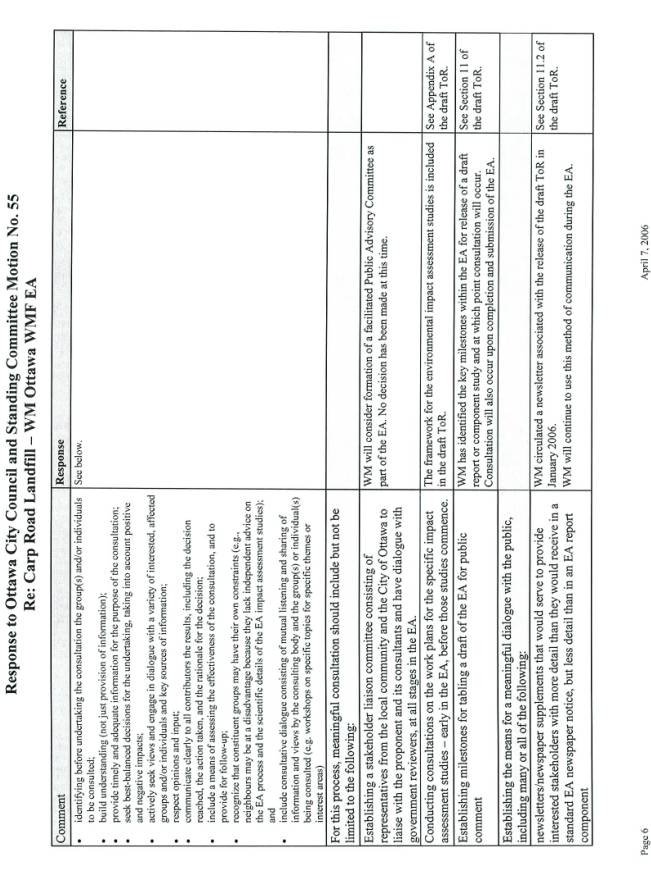
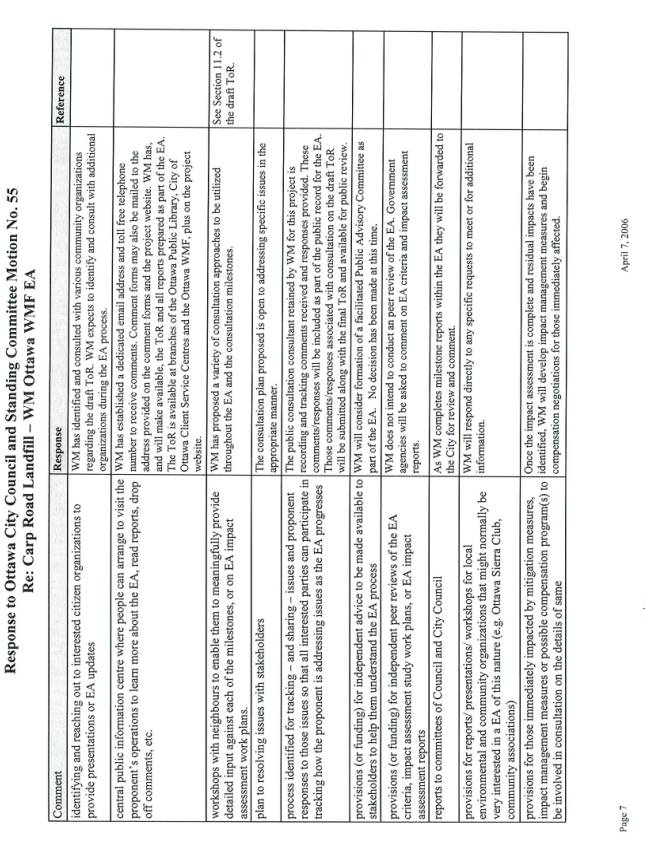
WM has provided a response (Attachment 2) to
the City’s concerns as set out in its 23 March Council motions and has
indicated where it will be revising the document. To date, however, WM has not agreed to extend their 12 May 2006
deadline for receipt of comments to the draft ToR and has indicated that they
will be submitting their final ToR to the MOE in June 2006.
The City’s comments will be forwarded to the
Ministry of Environment (MOE) and WM following the Council meeting of 14 June
2006.
Staff will be meeting with WM prior to the submission
of their ToR to the MOE. Both the
public and the City will have an additional opportunity to provide comments on
the final ToR upon posting of the document to the Environmental Registry. In addition, the EA for the landfill
expansion is expected to be a multi-year process with several statutory and
non-statutory opportunities to conduct public consultation and provide
comments.
In terms of the City’s ongoing
work, implementation of the
IWMMP has the complementary aim of conserving landfill capacity for the
long-term. It is important to appreciate that the
timeline to get new technologies on-line and implemented are comparable to the
establishment of new landfills or additional landfill waste capacity. In spite of waste reduction efforts and an extensive waste diversion
strategy, local landfill capacity will be required in the short and medium
terms for management of residual waste.
To continue on its efforts to achieve a 60% waste diversion target, staff
will be proceeding with a Request for Expressions of Interest (REOI) for
technologies regarding source separated organics and residual solid waste, and
a report on the results of this will be brought back in the fall of 2006.
RÉSUMÉ
À la réunion extraordinaire du Conseil le
23 mars 2006, ce dernier a adopté plusieurs motions en ce qui a trait au
site d’enfouissement du chemin Carp géré par l’entreprise Waste Management of
Canada (Waste Management) et de l’évaluation environnementale (ÉE) effectuée
jusqu’à présent.
À la suite de cette réunion, les employés ont
effectué une évaluation critique du document sur le projet de mandat (cadre de
référence) publié par Waste Management et ajouté les commentaires inclus à
l’annexe 1.
L’évaluation du document par les employés, qui
est requise comme première étape pour terminer
une ÉE complète, indique qu’il est généralement insuffisant sur le plan des
buts, des motifs et des possibilités de la proposition de l’expansion du site
d’enfouissement. De plus, il faut réviser le document attentivement pour
clarifier la proposition, les plans d’évaluation des choix et des méthodes de
rechange, et faire en sorte qu’il y ait un engagement envers une stratégie de
suivi complète de l’ÉE complète. Il faut fournir une documentation exhaustive à
l’appui ainsi qu’un engagement envers un processus de consultation plus complet
en créant un comité de liaison avec le public ou de consultations, un comité
consultatif technique et de communications et de liaison avec la collectivité.
Waste Management a répondu (annexe 2) aux
inquiétudes de la Ville qui figuraient dans les motions du Conseil du
23 mars et il a indiqué qu’il réévaluera le document. Par contre,
jusqu’ici, Waste Management n’a pas accepté de repousser la date d’échéance du
12 mai 2006 pour l’acceptation des commentaires sur le projet du
cadre de référence et il a indiqué qu’il enverra son cadre de référence final
au ministère de l’Environnement de l’Ontario en juin 2006.
Les commentaires de la Ville seront envoyés au
ministère de l’Environnement (MEO) ainsi qu’à Waste Management après la réunion
du Conseil le 14 juin 2006.
Le personnel rencontrera Waste Management avant
l’envoi de son cadre de référence au MEO. Le public et la Ville auront une
occasion de plus pour faire part de leurs commentaires sur le dernier cadre de
référence avant que le document soit inscrit au Registre environnemental. De
plus, l’ÉE sur l’expansion du site d’enfouissement devrait durer plusieurs
années, et il s’agira d’un processus ponctué de plusieurs possibilités
législatives et non législatives d’effectuer des consultations publiques et de
fournir des commentaires.
Pour ce qui est des travaux en cours de la
Ville, la mise en œuvre du PDGID a pour but complémentaire de conserver le site
d’enfouissement à long terme. Il importe d’apprécier le fait que les délais
pour obtenir de nouvelles technologies en ligne et les mettre en service sont
comparables à l’aménagement de nouveaux sites d’enfouissement ou aux travaux
destinés à renforcer la capacité de sites d’enfouissement déjà aménagés. Malgré
les effets visant à réduire les déchets et la stratégie complète de
réorientation des déchets, il faudra aménager des sites d’enfouissement locaux
à court et à moyen terme pour la gestion des déchets domestiques.
Afin de poursuivre son programme de collecte de
matières organiques et afin de réacheminer 60 % de ses déchets selon
l’objectif fixé, les employés prépareront une demande d’expressions d’intérêt
(DEI) pour les technologies afin de compléter le programme de collecte de
matières organiques séparées à la source et des déchets solides résiduels. Un
rapport des résultats sera présenté à l’automne 2006.
BACKGROUND
On 12 January 2006, Waste
Management of Canada Corporation (WM) released a draft Environmental Assessment
- Terms of Reference (ToR) document for public comment. The proposal under the ToR is for an
expansion of WM’s Ottawa facility, located on Carp Road at Highway 417, to
provide additional recycling, landfilling and composting capacity at the
existing landfill facility. At the
current filling rates and approved volumetric capacity, WM estimates that their
Ottawa facility has only four years of remaining use. The ToR document is the
first in a series of steps to satisfy the requirements of the Environmental
Assessment Act (EAA).
On 7 February 2006, WM held a
public information session/open house at the West Carleton Centre.
At that time, they requested that public comments on the draft ToR be
submitted by 20 March 2006. On 21
February 2006, following a request from staff, WM advised that they would
support a maximum extension for receipt of comments to 30 April 2006. At the request of Councillor Stavinga,
another community information session was held on 1 March 2006 at Ecole Jean-Paul
II in Stittsville. This meeting was
attended by over 1200 persons.
Following a meeting with staff and Councillor Stavinga, WM agreed
to the Councillor’s request to further extend the comment deadline to 12 May
2006. On 23 March 2006, Council adopted
several motions at a Special Council meeting respecting the Carp Road landfill
and the Environmental Assessment (EA) process conducted to date. This report
responds to the action requested in Motion 55/1.
On 28 March 2006, Councillors
El-Chantiry, Feltmate and Stavinga held a workshop regarding WM’s draft ToR,
attended by approximately 200 members of the public.
A further request was made to WM
to extend their deadline for comment to the draft ToR, but WM refused to do
so. Recognizing the timelines required
to present a staff report to Committee and Council, a letter dated 24 April
2006, was sent to WM by the City Manager confirming the expected schedule of
consideration of a staff report on this issue.
Attached to the letter was a preliminary summary of concerns regarding
the draft ToR. This information was
also copied to the Ministry of Environment.
Provincial Direction on Waste Management and Environmental Assessment
(EA) Policy
Recognizing a looming waste
management problem, Ontario governments in the late 1980s and early 1990s introduced
a variety of policies, regulations and funding programs to introduce, then
develop and enhance waste diversion, including the Waste Diversion Act, 2002. In June 2004, the MOE released a Discussion
Paper and conducted public consultation sessions on how to achieve the
Provincial-wide goal of 60% waste diversion with extensive discussions on
several key topics, such as:
·
Accelerating centralized composting for residential
waste and the feasibility of phasing-in a ban on disposal of key organics and
recyclable materials;
·
Renewing commitment on ICI waste diversion;
·
Reducing packaging and increasing the recycled content
in products and packaging;
·
Finding new waste diversion technologies; and
·
Initiating a Province wide monitoring system for waste.
Despite these efforts, Provincial
leadership has diminished in recent years, to the extent that in December 2005,
the Association of Municipalities of Ontario submitted a “Proposal for a
Provincial Integrated Waste Management Strategy”. In particular the Province has not taken any concrete action
directing the ICI sector to meet the 60% diversion goal, nor has it progressed
beyond guidelines for diversion relating to municipal solid waste.
In terms of Environmental Assessment (EA) policy, an extensive
three-year litigation action concerning the expansion of the Richmond Landfill,
finally confirmed the Minister’s authority to approve focused EAs. In late 2004-2005, the Minister of the
Environment appointed an expert panel to review and improve the EA framework. Despite receiving several recommendations,
the Provincial Government has not acted on the recommendations or announced any
new initiatives during the past year.
Thus, the EA to be completed for Waste Management’s Carp Road Waste
Management Facility (WMF) will proceed under the current EA process discussed
below.
Environmental Assessment Process
The Environmental Assessment
Act (EAA) provides for the protection, conservation and wise management of
Ontario’s environment by creating an accountable, logical and clear process of
provincial decision-making with significant opportunity for public review and
input. The Act promotes environmental
planning by requiring the “proponent” of an “undertaking”, such as a landfill
expansion proposal, to obtain approval of that undertaking by the Minister of
Environment prior to proceeding with the implementation of any significant
works.
In developing this EA process,
the Province has determined the various steps of the process, including the
opportunities for public input and comment and the Minister’s decision-making
requirements. It is important to
remember that a proponent, such as WM, embarks on the EA process with the
ultimate approval authority being the Minister of Environment. As such, the City – as host municipality –
is one key stakeholder amongst other stakeholders and will provide its comments
into the EA process to both WM and the Minister of Environment during the EA
process.
The EA process and timelines are
graphically summarized in the following flow chart.
|
|
Time Lines in
the Environmental Assessment Process
|
|
|
|
ToR Preparation
|
|
Regulated Time
Lines
|
|
Anticipated Time
Lines (1)
|
|
|
|
|
|
|
|
|
|
|
|
 Proponent prepares Terms of Reference (ToR) and
completes mandatory public consultation Proponent prepares Terms of Reference (ToR) and
completes mandatory public consultation
|
|
No Time Lines
|
|
12 - 52 Weeks
|
|
|
|
|
|
|
|
|
|
|
|
ToR Review and Approval
|
|
|
|
|
|
|
|
|
|
|
|
|
|
|
|
• Proponent submits proposed
ToR
• Government/Public Review (mandatory
30 day review)
• EAAB Analysis
• Minister's Decision
|
|
12 Weeks
|
|
12 - 24 Weeks
|
|
|
|
|
|
|
|
|
|
|
|
EA Preparation
|
|
|
|
|
|
|
|
|
|
|
|
|
|
|
|
 Proponent prepares EA and carries out mandatory
public consultation Proponent prepares EA and carries out mandatory
public consultation
|
|
No Time Lines
|
|
52 - 260 Weeks
|
|
|
|

|
|
|
|
|
|
|
|
|
|
|
|
|
|
|
Proponent submits EA*
|
|
Public Notice
|
|
|
|
|
|
|
|
|
|
|
|
|
|
EA Review &
Approval
|
|
|
|
|
|
|
|
|
|
|
|
|
|
|
|
  Government/Public Review of EA* Government/Public Review of EA*
|
|
7 Weeks
|
|
7 Weeks
|
|
|
|
|
|
|
|
|
|
|
|
|
|
|
|
|
|
|
|
 EA Review/Notice of
Completion * EA Review/Notice of
Completion *
|
|
5 Weeks
|
|
5 Weeks
|
|
|
|
|
|
|
|
|
|
|
|
|
|
|
|
|
|
|
|
 Final Public Comment Period Final Public Comment Period
|

|
5 Weeks
|
|
5 Weeks
|
|
|
|
|
|
|
|
|
|
|
|
|
|
|
|
|
|
|
|
• Project Officer evaluates submissions,
negotiates conditions and finalizes
recommendations to Minister
• Minister's Decision
|
|
13 Weeks
|
|
13 Weeks
|
|
|
|
|
|
|
|
|
|
|
|
|
|
|
|
|
|
|
|
Approve/Deny
|
|
|
|
|
|

|
|
Refer to Hearing
|

|
Minister Sets Time Lines
|
|
24 - 52 Weeks
|
|
|
|
Refer to Mediation
|
|
|
|
|
|
|
|
|
|
|
|
|
|
|
|
* Director may issue
Deficiency Statement
|
|
|
|
|
|
|
|
|
|
|
|
|
|
|
|
|
|
|
|
|
|
SOURCE:
|
A Guide to Preparing Terms
of Reference for Environmental Assessments (Draft), Ministry of the
Environment, December 15, 2000
|
|
|
|
|
|
|
|
|
|
|
|
Current stage of Ottawa WMF
EA
|
|
|
|
|
|
|
|
|
|
|
|
|
|

|
|
Public Consultation
|
|
|
|
|
|
|
|
|
|
|
|
|
|
(1) Subject to
Ministerial extension based on need to resolve outstanding issues.
|
|
|
As noted on the graphic, WM is at the first stage of
developing a draft Terms of Reference (ToR) in the current EA process for the
Carp Road Waste Management Facility (WMF), which will be submitted to the MOE
for approval.
Terms of Reference Content
The ToR sets out WM’s plan for
addressing the legislated requirements of the EAA. The ToR outlines the type of work that WM considers necessary to
study and address the environmental issues that have been identified and to
prepare the EA document detailing the investigation of environmental issues.
In general, a ToR identifies the purpose of the
proposal, provides a general description of both the proposal and the
environment that may be potentially affected by the landfill expansion and
activities, outlines the alternatives that will be considered in the EA and
identifies the broad issues that need to be assessed. The ToR is not intended to examine in detail the potential
environmental impacts, nor is it intended to identify or develop any or all
mitigation requirements. The EA process
then proceeds to examine and assess all aspects of the undertaking identified
in the approved ToR.
The ToR should also include a
description of the consultation that will take place during the preparation of
the EA.
A complete ToR submission has
four components:
·
a transmittal letter to the MOE Project Officer that
summarizes the proposed undertaking and that outlines the reasons that the
proposed ToR should be approved;
·
the proposed ToR;
·
a consultation record that outlines the public
consultation carried out during the ToR preparation; and
·
supporting documentation as required.
The following information is
required to be included in the proposed ToR by the applicant:
·
identification of the proponent (WM);
·
explanation of the purpose of the proposal (landfill
expansion in this case);
·
description of the proposal;
·
alternatives to the undertaking and alternative methods
of carrying out a proposal;
·
description of the existing environment and potential
effects;
·
identification of methods that will be used to assess
the potential environmental impacts and evaluate the results of any studies,
research, surveys or tests that will be undertaken during preparation of the
EA;
·
monitoring strategy and schedule;
·
EA consultation plan reflecting the input received from
the public, agencies, stakeholders, First Nations and interested parties;
·
flexibility in the ToR to accommodate new
circumstances; and
·
other approvals required and related issues.
Two weeks prior to submission, WM
will submit a completed Terms of Reference Summary form to allow the Summary to
be posted on the MOE website. WM must
also publish a notice in a place or places) appropriate to the community to
inform the public that a ToR has been submitted for the proposed undertaking. The notice will advise the public of where
the submission can be reviewed and will invite comments to the Minister during
the 30-day review period. WM is not yet
at this step in the process.
Once public notices have been
prepared, WM will formally submit the ToR package to the MOE. In both the transmittal letter for the
submission package and in the ToR, WM should note under which clause of the EAA
the ToR is being submitted (s.6(2)(a), (b) or (c)) to indicate whether the
company is undertaking a full or focused EA.
The Minister has three options
regarding ToR approval: The Minister
may approve the ToR, approve the ToR with Ministerial modifications, or refuse
the ToR. The Minister will only approve of the ToR “if the Minister is satisfied that an environmental assessment prepared
in accordance with them will be consistent with the purpose of this Act and
with the public interest”. Should there remain significant issues, the
Minister may decide to refer them to mediation throughout the ToR preparation
and evaluation process.
Once the proposed ToR is formally
submitted to the MOE, however, it is subject to the deadlines regulation (O.Reg.
616/98), which establishes the timing of reviews and decisions. The Minister must make a decision about the
proposed ToR within twelve (12) weeks of the commencement of regulated
timelines. While the Minister will
likely make every effort to meet the deadlines prescribed in the regulation,
the Minister’s decision is not invalid if the decision was not made before the
applicable deadline. There are also
provisions within the EAA and the deadlines regulation that adjust the
deadlines in the event of an amendment to the proposed ToR by the proponent, or
if any matter is referred to mediation.
The Director of the EAAB may also choose to extend the approval deadlines
if extraordinary circumstances exist to justify the extension.
An approved ToR represents an
agreement between WM and the Minister about the work that is required in the EA
to determine the potential impacts of the landfill expansion proposal and its
alternatives on the environment.
Although the ToR document is intended to be comprehensive, in some cases
the results of the work undertaken may indicate that additional work is
required to fully assess the applicant’s proposal.
The approved ToR will play a
significant role in the Minister’s decision about the approval of the EA to
proceed with the proposal. If an EA
document does not meet the commitments made in the approved ToR, the Minister
may choose to deny the application to proceed.
Environmental Assessment
Phase
Following approval of the ToR, WM
will carry out the actual environmental assessment itself. This step will
involve conducting the various studies and assessments that have been
identified as necessary assessments in the EA Terms of Reference.
Once a ToR has received Ministry
approval, it is appropriate for the proponent to facilitate the creation of
various review teams such as a government review team (GRT), public advisory
and technical advisory committees etc. to help ensure that potential issues are
identified and resolved.
This step of the assessment is
the longest in duration as it involves the preparation of the many studies and
may involve consultation at the discretion of WM.
Submission of the EA Document
WM is required to give public
notice of their formal submission of its EA document. Once the above notice has been given, the public has a minimum of
thirty (30) days to make a written submission to the MOE regarding the proposal,
the EA and the MOE review. During this
time, anyone, including WM, may make a written request to the Minister
suggesting:
·
what issues are outstanding;
·
how these might be resolved through specific conditions
of approval; and
·
whether a hearing should be held by the Environmental
Review Tribunal (ERT).
Provincial Review and
Decision Making Process
The EAAB coordinates a review of
the document soliciting comments from various participating committee members,
First Nations and the public. The MOE
review documents any shortcomings identified and assesses how the requirements
of the EAA have been addressed. As
well, the MOE review will also identify whether the preparation of the EA
document has been carried out in accordance with the approved ToR.
Ultimately, the Minister will
decide whether to:
·
refer all or part of the matter to the ERT for a
hearing, or for a decision;
·
refer the EA or a particular issue to mediation; or
·
approve the proposed undertaking and any conditions of
the approval.
If a hearing is not required, the
Minister may give approval or deny approval.
Cabinet must ratify the Minister's decision.
If the
Minister refers all or a portion of an application for a hearing, the ERT must
schedule and provide notification of the public hearing. The ERT may approve or refuse approval of
the proposal. A decision by the ERT
comes into effect twenty-eight (28) days after it is issued, unless the
Minister, with Cabinet approval, varies the decision or requires the ERT to
hold a new hearing.
The Deadlines Regulation
provides for the Minister to make a decision on an EA submission with thirty
(30) weeks of submission to the MOE.
A current full EA process from
start to finish, including preparation and submission of a ToR and EA
documentation for a waste management facility expansion proposal - assuming no
major public opposition - usually proceeds over a three to four year
timeframe.
·
A process that will be as complete as reasonably
possible by including all individuals, agencies, groups and other bodies that
may have an interest in the proposal.
·
Ensuring that the consultation process is open to all
potentially affected or interested parties.
This includes consultation in both official languages of Canada, as
required by law, policy and/or by circumstance, and in other languages as
circumstances dictate.
·
Consultation must be transparent by documenting the
consultation process that is carried out for the development of the EA so that
the process can be understood and traced.
·
The process must be responsive by providing
opportunities for stakeholders to comment on the development of the EA and
responding to comments received in a timely manner.
·
The consultation must be meaningful by identifying how
comments and concerns have been considered throughout the EA process.
·
Flexibility in the process to allow for response to new
issues that may emerge as the EA proceeds.
Comments on WM’s
Draft ToR
Staff conducted a thorough
assessment of the draft ToR document released by WM. This assessment is a critical component in
the City’s review of the “environmental soundness” of WM’s
landfill expansion proposal. The review
has included comments from Councillors, residents, and Public Health in
addition to those of the Public Works and Services Department. The assessment has been conducted from a
technical and objective perspective to ensure that the application addresses
the full spectrum issues of environmental, social and economic sensitivity,
community partnerships and legislative and regulatory requirements.
Many landfill expansion proposals
conducted in Ontario have proceded as focused or scoped EA’s. WM has
stated that its intent to conduct a full EA; however, in many respects the
draft ToR reads as a scoped or focused EA.
Staff met with WM representatives on three occasions to discuss the
contents of the draft ToR and Council’s initial motion of 23 March 2006. At each juncture, WM confirmed that it is
their intention to conduct a full EA and that they will be reviewing the draft
ToR with the EAAB following the submission of all public comments. This fundamental disconnect with its stated
purpose has clouded the overall acceptability of the document and requires
revision by WM. The City, as indicated in Motion 55/1, is supportive of WM’s stated intent of conducting a full
environmental assessment of the Carp Road Landfill Expansion, particularly as
it is not evident that WM has undertaken any preliminary investigations or
evaluations which would support undertaking a scoped EA to meet MOE
requirements.
As a key stakeholder in the
process and as the host community, the City’s comments and concerns will be
given serious weight and consideration by the EAAB of the MOE. However, the
ultimate decision making authority for all steps in the EA process rests with
Minister of Environment.
WM Response
Provincial Response
Following the Council meeting on
23 March 2006, the City Clerk forwarded a letter to the Province requesting
that it “…conduct a comparative analysis of the environmental and health
impacts of the use of landfill, incineration, and other emerging technologies,
and in setting environmental and health guidelines for the use”. The Director
of EAAB has responded to this in a letter dated 04 May 2006 indicating that the
Province, through its regulations on Landfills and Air Quality standards
adequately safeguard the environment, and on this basis has declined to
undertake the requested analysis.
Future Steps & EA
Timeline
Next Step – City of
Ottawa
Following formal consideration and approval of
the attached City ’s comments at the 14 June 2006 Council meeting, they will be
forwarded to the MOE and WM for consideration in finalizing the ToR.
Staff will continue to follow WM’s progress
through the Environmental Assessment process.
It is anticipated that staff will regularly bring forward other reports
on any other comments through the various stages.
Next Steps - WM
Once all of the public comments
are submitted to WM, its consultant will categorize the feedback received
according to themes and present the information in a consultation document.
WM has indicated a tentative project timeline that projects the
ToR, public consultation results and supporting documents being completed by 19
May 2006 and submission to the MOE in June 2006. The revised ToR will be posted on the Provincial Government’s
Environmental Registry to start the mandatory twelve (12) week public and
agency review period.
The responsibility to oversee the
EA process then shifts to the MOE. The
public and technical review agencies may then submit their comments to the MOE
for their consideration in assessing the completeness of the ToR
application. If the tentative timeline
is followed, the Minister’s decision on the ToR will be forthcoming in the fall
of 2006. At that point, the Minister’s
decision may either approve, approve with modifications or refuse the ToR. If refused, the ToR may be revised and
re-submitted. If approved, WM will commence work on the preparation of the EA within the
context of the approved ToR. WM will conduct public consultation on the EA and the Ministry
will also accept comments on the EA and the Ministry’s review of the EA.
In summary, there are at least
three (3) more statutory-mandated opportunities to provide comments to WM (once on the ToR that are submitted and once on the EA) and
the MOE (once on the Ministry Review of the EA document) in the EA process.
RELATED INFORMATION
Council’s 23 March 2006 motion
included direction “that the staff report being prepared on the issue include a
detailed explanation of the City’s plan and timelines to meet Ottawa’s 60%
waste diversion target.” In response
the following information is provided.
City of Ottawa Integrated
Waste Management Master Plan
The City has responded to the
guidelines on solid waste management issued by the Province through the Council
approved Integrated Waste Management Master Plan (IWMMP). Currently, it delivers the following broad
spectrum of residential solid waste services:
- Collection and disposal of municipal solid waste,
- Diversion of material from landfill through:
- Blue and Black Box recycling programs;
- Leaf and Yard Waste collection;
- Take It Back program;
- Compost Plus organics pilot project; and
- Household Hazardous Waste programs.
In 2005, this resulted in the
collection of 319,500 tonnes of residential waste of which 108,949 tonnes was
diverted. The overall residential solid
waste diversion from landfill for the City is 34%.
From information staff have been
able to collect from private waste collection and landfill contractors over
twice as much solid waste was collected from the ICI sector, with only 17.5% of
that diverted from landfill. These services are provided directly to local
businesses, employers and service providers through private contractors.
While the City is not responsible
for industrial, commercial or institutional (ICI) waste collection, diversion
and disposal services, Council’s recent decision to offer waste collection and
diversion service to the small business community through the Yellow Bag
program, does provide a segment of the ICI community with enhanced options for
diversion from the waste stream.
In accordance with the
IWMMP, staff has continued to develop
the following activities to maximize waste diversion and minimize landfill
capacity consumption:
q A comprehensive education and waste diversion promotion campaign is
planned to commence this spring. It is
expected that Councillors will play an integral role in this education
campaign.
q A report is in development for the new solid
waste collection and management by-law.
Authority for reduced residential garbage bag limits will be included as
part of the new by-law.
q
In November
2005, Council approved city-wide contracts with deployment options for the
residential organics composting program for potential implementation in 2008 to
further increase diversion and reduce requirements for landfill disposal.
q A Request for Qualifications for organics
processing of the City’s source separated organics and marketing of any
resulting products was released for private sector submissions. Staff will
proceed with the issuance of a Request for Proposals and report to Committee
and Council on the outcomes in 2007.
q
A Request
for Expression of Interest (REOI) for new technologies pertaining both to the handling of source
separated organics and the residual solid waste stream is undergoing final
revision and is to be issued in June 2006. Staff will provide a
summary review of this Alternative Technologies REIO to Committee later this
year.
q
Staff plan to undertake an update of the Waste
Characterization study for the residential and ICI sectors with the information
to be made available to both the public and private sectors. This exercise will assist the City in potential
selection of alternative technologies and as such, financial and staffing
requirements will be identified as part of the 2007 Budget process.
In summary, staff are currently
or will in the immediate future, undertake a variety of measures as noted
above, to minimize the residual solid waste stream and become more effective at
identifying resource potential. With
specific reference to the attainment of 60% diversion, it is anticipated that
the comprehensive education and communication program, in conjunction with
reduced bag limits and source separated organics program implementations, will
enable the City to reach our diversion target by year end 2008.
ENVIRONMENTAL
IMPLICATIONS
The EAA sets forth a broad planning framework
to allow for the implementation of major proposals, such as this one pertaining
to Waste Management of Canada Corporation’s Landfill Expansion. Through the requirements of the
Environmental Assessment Act, it is expected that an objective, reproducible,
transparent and thorough process will be followed in consideration of the
proposal at hand.
RURAL
IMPLICATIONS
Residential, industrial, commercial and
institutional waste from both rural and urban areas is accepted at the Carp
Road Landfill.
CONSULTATION/PUBLIC
NOTIFICATION
WM conducted the mandatory public meeting on
their draft ToR on 7 February 2006. They held a second public meeting at the
request of Councillor Stavinga on 1 March 2006.
Council held a special meeting on 23 March 2006
to consider and approved Motion 55/1 documenting the City’s concerns with the
draft ToR. At this meeting Council also adopted Motion 55/11 to provide local
groups with funding to allow them to participate technically in the
Environmental Assessment process. These agreements are now in place and will
allow these groups to provide meaningful, knowledgeable input on these
important initiatives.
The area Councillors (El Chantiry, Feltmate and
Stavinga) hosted a public meeting on 28 March 2006 to discuss alternative
technologies.
Councillors and staff have received many emails
from members of the public on this issue.
These emails have been assembled, printed and filed with the Committee
Secretariat as part of their placement on the public record. Staff reviewed public submissions and those
provided within the Community Action Forums conducted to date and have
integrated relevant ToR comments in staff’s detailed comments, where appropriate.
Public Works and Services staff received and
included comments from Public Health in the detailed comments found at
Attachment 1.
Staff have also met with WM representatives on
three occasions and exchanged correspondence discussing their draft ToR and
timelines. WM have stated their willingness to meet with City staff prior to
finalizing the ToR for submission to the MOE however intends to submit the
final ToR directly to the Ministry of the Environment.
FINANCIAL
IMPLICATIONS
There are no direct financial implications to
the City with respect to WM’s proposed ToR.
The City anticipates future review work will consume staff time and
external consulting services, to be determined.
SUPPORTING
DOCUMENTATION
Attachment 1 - Staff Comments on WM EA draft ToR – 1 May 2006
Attachment 2 - Response to Ottawa City Council and
Standing Committee Motion No. 55/1
Re: Carp Road Landfill – WM
Ottawa WMF EA – 7 April 2006
Attachment 3 - Figure 1 Base Map of 3 km radius around WM
Ottawa WMF
DISPOSITION
1. Public
Works and Services staff to forward Attachment 1 to WM of Canada Corporation and to John
McCauley, Gartner Lee Limited, Suite 1603, 275 Slater Street, Ottawa ON K1P
5H9, ottawalandfillea@gartnerlee.com.
2.
Public Works and Services staff to forward this Report
to the Ministry of Environment – Environmental Assessment and Approvals Branch,
attention Hayley Berlin, Project Officer, Environmental Assessment Project
Co-ordination Section, 2 St. Clair Avenue West, Toronto, ON M4V 1L5, (416) 314-7106, Hayley.Berlin@ene.gov.on.ca.
|
Document Reference
|
Specific Comments
|
|
1. Introduction
|
|
|
3. Purpose of
the Proposed Undertaking
|
|
|
3.2 Opportunity Assessment
|
|
|
5. Description and Rationale for the Proposed
Undertaking
|
|
|
5.1 Description of the Proposed Undertaking
|
|
|
5.2 Rationale for the Proposed Undertaking
|
|
|
6. Description and Rationale for “Alternatives To” the
Undertaking
|
|
|
7. Description
and Rationale for “Alternative Methods” of Carrying Out the Undertaking
|
·
Alternative technologies assessment: A full EA
focusing on Technology, Methods, Processes is required
·
Regarding Landfill Footprint Alternatives – City
approval will also be required to permit the use. A zoning amendment would be required for the North and West
“Footprint” Alternatives. What is not
clear is the implication of the term “stand alone facility”. Is the alternative “stand alone facility”
considered by MOE to be an expansion of the existing site? If so, then an Official Plan amendment
would also be required to permit the use (Surface Operations and
Traffic). Also, a “stand alone
facility” implies that a new Certificate of Approval, as opposed to an
amendment to the existing Certificate of Approval, may need to be
sought. WM should clarify this issue.
|
|
8. Description
of Environment Potentially Affected by the Proposed Undertaking
|
·
The description of environmental conditions is
focused on the area in the immediate vicinity of the existing facility. The MOE Guide for preparing EA ToRs
indicates that the environmental components that could be affected by the
proposed undertaking and its alternatives should be described. Recognizing that WM is considering
alternatives in various locations, the description of environmental
conditions should be expanded to match these alternatives. As the majority of the waste stream is
generated from Ottawa, City boundaries should be used as the basis for the
existing conditions description.
·
The EA ToR does not outline how more detailed
baseline conditions for assessment, monitoring and mitigation for air, noise,
odour, wastewater or leachate issues will be developed in the EA. This should be provided as per the EA ToR
Preparation Guide.
·
As per the Guide, WM is to include a general
description of the types of effects that can be expected from the
undertaking. This could be
accomplished by linking the presented assessment criteria in Appendix A to
the possible effects from such a facility.
·
The gas collection system capture rates and plan
should be included in the ToR.
·
Air quality/odour:
Assessment of air quality and odour must be established on a threshold
basis as the DATUM; not existing conditions suggested in the draft ToR.
·
The Tof R should specifically include all community,
social, economic and environmental issues including but not limited to the
listing included in Schedule A of Motion 55/1.
|
|
9.
Environmental Assessment Methodology
|
|
|
9.1 Evaluation of “Alternatives To” and “Alternative
Methods”
|
|
|
9.2 Detailed Assessment of the Undertaking
|
|
|
11.1 Consultation on the Terms of Reference
|
|
|
11.2 Consultation Plan for the EA
|
·
Given the high level of interest and concern with the
proposed undertaking, it is suggested that a more detailed consultation plan
be provided in the EA ToR that would include principles that will guide the
consultation program throughout the EA process. Also a more interactive public engagement program is warranted.
·
The City requests that WM include a Technical
Advisory Committee and a Community Liaison/Communications Committee to be
funded by WM and made part of the EA process. WM should furtherFel agree to a facilitated EA process with a
broad representation of interested parties as indicated in Motion 55/1.
|
|
12. Other Approvals
|
·
The draft EA ToR identifies two other approvals: Environmental
Protection Act and Planning Act (depending on the preferred
alternative). The draft ToR should
also identify Ontario Water Resources Act and Aggregate Resources
Act approvals, if required.
|
|
List of Figures
|
|
|
Appendix A Environmental Assessment Criteria and
Studies
Other Comments:
|
·
A long-term leachate quality assurance/quality
control (QA/QC) plan and remediation process should be included in the ToR.
·
Assessment for advanced waste processing and
options/costs for consideration should be included in the draft ToR.
Comments from
Public Health
Appropriate buffer zones
·
WM must provide how the buffer zones between the WMF
and existing, and potential, development be determined and maintained and
what the extent of the buffer zones will be.
Access to site
·
WM must include a plan of how access to the site will
be monitored and how the entrance by non-authorized personnel onto the site
will be enforced.
Monitoring of wastes
·
WM should provide the control measures that will be
put in place to ensure that hazardous wastes are not disposed of at the site.
Surface water
·
WM should provide a plan for diversion of surface
run-on from the WMF. Where will
surface run-off be diverted and what measures will be put in place to ensure
the run-off does not impact surface waters?
What contingencies are in place in case of prolonged heavy rainfall
causing flooding conditions? WM must
provide an assessment and plan to address these surface water issues.
Wellhead protection area
·
Research must be undertaken to demonstrate that the
WMF does not encroach on a ground water wellhead protection area.
·
WM must provide information on the type of liner that
will be used. WM must advise what
measures will be in place to monitor the efficiency of the liner and what
contingencies will be put in place in case of a liner malfunction? An investigation must be undertaken to
demonstrate that there is no hydraulic connection between the bottom of the
liner and the shallow ground water.
Details must be provided as to the final outcome of the leachate (i.e.
recycled into landfill, disposal at treatment plant, treatment on-site).
Ground
water
·
WM must provide details on the measures put in place to ensure that
the shallow and deep aquifers are not impacted by the WMF, as well as details
of the shallow and deep aquifer monitoring program. Contingencies must be put in place in case of an impact from
the WMF on either or both aquifers.
Air
quality
·
WM must provide details regarding the control of landfill gases
(explosive and odours) and details related to the monitoring of landfill
gases, both above and below ground surface (i.e. along fissures in rock,
utility lines). Contingencies must be
in place in case of an accumulation of landfill gases capable of causing an
explosion or contributing to odour problems.
Details must be provided as to the control of landfill gases (i.e.
passive/active gas collection) as well as their treatment (i.e.
combustion/noncombustion, energy recovery) in order to alleviate explosion
hazards and odours. Information
should be provided as to the potential impact of the landfill gas treatment
method to the outdoor air quality, including potential contributions to green
house gases.
Vermin
and litter control
·
WM must provide details related to the control of vermin and
scavengers, including rodents and birds, as well as to the control of litter
on and off-site.
Dust
and particulate matter control
·
WM must provide details related to the control of dust and
particulate matter on and off-site, and if applicable (i.e. an increase in
vehicle traffic associated with the WMF), along the transportation route.
Noise
control
·
WM must provide details related to the control of noise on and
off-site, and if applicable (i.e. an increase in vehicle traffic associated
with the WMF), along the transportation route.
Transportation
·
WM must provide information regarding the contingencies that must be
in place in case of accidental spills or leaks along the transportation
route.
Final
cover and closure
·
WM must provide details related to the design, construction and
maintenance of the final cover.
Contingencies must be in place in case of a malfunction in the final
cover. Details must be provided
related to the after-closure care of the landfill, including details on the
after-closure monitoring activities; these details must also include how long
the after- closure care will be undertaken.
|
Comments
on Environmental Assessment (EA) Draft Terms
of Reference released by Waste Management of Canada Corporation for the Carp
Road Waste Management Facility
commentaires sur le cadre de référence
préliminaire de l'évaluation environnementale (EE) publié par Waste Management
of Canada Corporation pour l'installation de gestion des déchets du chemin Carp
ACS2006-Pws-utl-0011 CITY-WIDE / À
L'ÉCHELLE DE LA VILLE
Mr. Ken
Brothers, Director, Utility Services, Public Works and Services Department,
introduced Mr. Michael Benson, of Conestoga-Rovers Consultants and Ms.
Anne-Marie Fowler, Manager, Solid Waste Services, Public Works and
Services. Mr. Brothers gave a
PowerPoint presentation on City staff’s response to the Terms of Reference
prepared by Waste Management Canada (WMC) to expand the Carp Road Waste
Management facility. The presentation
included an update on the City’s Integrated Waste Management Master Plan
(IWMMP), information on current and future residential waste diversion programs
and the need to examine new and emerging technologies. Mr. Brothers also noted that provincial
direction and support would be required to meet the 60% diversion targets for
Industrial, Commercial and Institutional (ICI) waste.
Mr. Benson
gave a detailed presentation on the Environmental Assessment Process, noting
that WMC is at the start of an exercise that will include government and public
review of the Terms of Reference (ToR) during a 12-week period (which can be
extended by the MOE) prior to receiving the Minister’s decision on the Terms of
Reference.
Mr. Brothers
detailed staff’s comments on the Draft ToR indicating these would be forwarded
to the MOE after the June 14, 2006 City Council meeting. With regard to WMC’s schedule, Mr. Brothers
said its next steps would include finalizing the ToR and preparing all the
supporting documentation for submission to the MOE for posting on the
Environmental Registry in June. The
Minister’s decision is expected in September.
Prior to hearing public
delegations, Committee Vice-Chair Peggy Feltmate read out five Motions meant to
address the following areas of concern:
·
Ensuring Compliance of Existing Operations –Public
Accountability and Trust;
·
Deficiencies in the Terms of Reference – Need for
Adequate Public Review of Revisions;
·
Support for the Communities’ Response
·
Accelerating City Actions on 60% Waste Diversion
Target
·
Provincial Action Required for Industrial,
Commercial and Institutional (ICI) Waste.
The
Councillor thanked her colleagues, Councillors Janet Stavinga and Eli
El-Chantiry, and City staff for their hard work with citizens’ coalitions and
their help in drafting the Motions. In
reply to Councillor Feltmate’s question, Mr. Richard Hewitt, Acting Deputy City
Manager, Public Works and Services, confirmed that staff reviewed the Motions
and found these contained nothing contrary to the contents of the staff report.
Councillor
Gord Hunter suggested that Motion 4, which deals with accelerating the waste
diversion target, was outside the discussion on the Terms of Reference. He expressed the hope the discussion would
remain focused and that Motion 4 would be ruled Out of Order at this time. Chair Peter Hume said he would take this
under advisement and consult with Legal Services staff.
Chair Hume
asked whether staff have information on the composition of the ICI waste
stream. Mr. Brothers admitted that the
last “characterization” of ICI wastes was done years ago, however a full
assessment would be undertaken in 2007.
He added that the characterization of waste at the Carp Road facility
was up to WMC and City staff have commented to that effect.
Councillor
Alex Cullen referred to the chart “Total Waste Landfilled by Location”, and he
inquired about the impact on capacity at the Trail Road landfill site should
the expansion of Carp Road facility not be approved. Mr. Brothers replied that construction/demolition and ICI
materials would be privately disposed of but some of this material would likely
end up at Trail Road. If all the
material went to Trail Road, the remaining capacity would be 4 to 5 years. In response to a further question from
Councillor Cullen, Mr. Brothers said that accepting all residential waste at
Trail Road would result in a three-year reduction to the eleven-year capacity
left there. The Councillor asked
whether the 60% diversion target also applied to the ICI sector. Mr. Brothers said the staff report
states that the Province has not been as diligent as it could have been in
helping industries with ICI waste diversion.
He confirmed that the responsibility for bringing the ICI waste
diversion target to 60% rests with the Province.
Councillor
Janet Stavinga asked why staff are not recommending rejecting the Tof Rs if
they find them deficient and further, should WMC choose not to amend the ToRs
to reflect City and community concerns, would staff report back to Committee
highlighting deficiencies and ramping up the process. Mr. Benson responded by saying that the responsibility for
adopting or not adopting the ToRs rests with the Province. He added, to respond to the second part of
Councillor Stavinga question, that in the event that multiple versions of the
ToRs were deemed not to have addressed the City’s concerns, the Minister would
step in. He thought that City Council
could also step in but he advised that a legal opinion on Council’s authority
in this regard be secured.
Chair
Peter Hume pointed out that once the City gets into the ICI sector, it will be
looking into its own operations and lead by example. Mr. Brothers agreed this is one of the things the City needs to
do, and staff will be reporting back with an assessment of the cost of
expanding recycling measures. Chair
Hume suggested there be a sixth Motion, “leading by example” to ensure that, in
terms of the IWMMP process, City facilities take on a leadership role in terms
of ICI sector waste diversion. Vice
Chair Feltmate agreed this 6th Motion could be added to the five she
presented earlier.
Presentations from the Public
Mr. Paul
Koch, former Chair and Member, Environmental Advisory Committee (EAC) referred
to correspondence from Mary Hegan, EAC Chair which provides detailed
information on the research undertaken by the EAC and lists seven (7) areas of
basic concern along with other comments on the draft ToRs. Mr. Koch then outlined three recommendations
for the Committee’s consideration:
·
That
Council urge the Ontario Minister of the Environment (MOE) to reject the Tof
Rs;
·
That
Council instruct senior staff to amend their critique of the draft ToRs to
articulate the clearest and strongest possible reasons why the ToRs should be
turned down;
·
That Council instruct senior staff to review the IWMMP
and report back on how the City will reduce residential waste disposal to 30%
by the end of 2007; expedite the early adoption of waste disposal technologies
and exercise true leadership / stewardship in establishing ambitious but
achievable, publicly-endorsed diversion
targets, in cooperation with the Province.
Copies
of Mr. Koch’s presentation and Ms.
Hegan’s correspondence are on file with the City Clerk.
Mr.
Raymond Moffatt, representing a coalition of four groups: the
Richardson Corridor Community Association, the Stittsville Village Association,
the Ottawa Landfill Watch and the No Dump Committee, spoke about the origins of
the coalition. For 13 years, residents
tolerated the nuisances from the dump, but when they heard about the proposed
expansion, they became incensed and began to mobilize. He went on to say that the coalition has
produced, with the help of doctors, lawyers, parents, youth, engineers,
business people and politicians, a 4-volume, 1000 page response to the 50-page
Terms of Reference from WMC. Over 650
comments out of the 2600 received via community organizations question WMC’s
assertion that not allowing the landfill site to expand would have detrimental
impacts on the ICI sector. Over 750
comments speak to the collision between growing communities and the nuisance
from the growing mountain of thrash.
The coalition has also received over 1000 comments in opposition to the
expansion.
Mr.
Moffatt said people are questioning the need and alternatives and say the site
is not suitable. The coalition supports
the direction of the staff report, supplemented by the Motions outlined by
Councillor Feltmate, and wants the City to revise its IWMMP, with a view to
landfill expansion not being the best option.
Dr. Metin
Akgun, Stittsville Village Association, spoke about the
economic impact and the conflict between landfill growth and housing and
business growth. He pointed out that,
in 2005, there were 2000 residents within 3 km of the site, 21,000 within 6 km
and approximately 95,000 within 10 km: it is projected that, by 2015,
approximately 120,000 will be living with 10 km of the site. Dr. Akgun went on to say that the issue did
not only relate to proximity to the site.
There exists a problem caused by the prevailing wind patterns, with
people currently as far away as Kanata Lakes are complaining about odours and
toxic gases emanating from the landfill site.
The Stittsville Village Association has submitted a document dated 11
May 2006, entitled Comments on the Draft Environmental Assessment Terms of
Reference of Waste Management of Canada Corporation, Ottawa Waste Management
Facility. This document is held on file
with the City Clerk.
John
MacMillan – Co-founder, Ottawa Landfill Watch, made the following suggestions for
viable alternatives to keeping the Carp Road facility open beyond 2010, when it
is due to close:
·
Collect 150,000 tonnes of residential and ICI
organics by 2008-2009;
·
Use the existing landfills, Trail Road, Springhill
and Laflèche;
·
Increase ICI diversion from 17.5% to 40% over the
next three to four years;
·
Increase the City tipping fees to $125/tonne after
the landfill closes.
Mr.
MacMillan put forward the view that keeping the Carp Road landfill open was
neither necessary nor desirable. He
cited gasification and incineration as examples of other alternatives, along
with residential diversion incentives such as clear garbage bags, weekly 2-bag
limits and provincial diversion incentives such as a ban on
organics/recyclables in landfills and similar programs.
Peter
Mantas, a resident of Stittsville and a trial lawyer, provided the Committee
with a copy of a claim citing both WMC and the City of Ottawa as Third Party
claimants in a suit by Metcalfe Realty Company Ltd, alleging that leachate
contamination from the landfill is devaluating a large tract of land it owns
across from the dump. Mr. Mantas
suggested the City take action to disengage itself from the landfill site and
not rely on a facility embroiled in litigation relating to environmental
contamination. He said that, in the
coalition’s view, the MOE cannot allow the expansion of the dump when it
alleges as the Crown that WMC failed to monitor waste being brought onto the
landfill properly; caused contaminants to be discharged into the environment
and failed to minimize leachate leaks.
Dr. Carla Miner, a Physicist with 20 years’ experience, listed
the following as material oozing from a pile of wet garbage: dissolved
liquids; bacteria and parasites; solvents, petroleum; pesticides;
pharmaceuticals; heavy metals and PCBs and flame-retardants. Leachate can also filter through rock and
come into contact with the water table.
She pointed out that, for the first thirty years of its operation, there
was no leachate control: in 1997, a partial liner was installed, followed by
purge wells in 2000. Dr. Miner
continued by saying that leachate was first detected in 1982 and has been
steadily migrating until it was found in wells in 1987. Dr. Miner concluded her presentation by saying
that the site has caused wide-spread groundwater contamination. Control measures have been inadequate and
expansion will make the situation worse.
Many residents drink from the aquifer and having to provide city water
to them would be a costly undertaking.
Colin
McKeown spoke about a unique, genetic strain of brook trout in Poole Creek,
which is very sensitive to contamination.
He said that, although the extent of the leachate plume is not known, it
is believed to have expanded and possibly reaching Poole Creek. Mr. McKeown added that the University of
Ottawa is currently testing the water of Poole Creek for contaminants. There is also more than likely an impact on
the Carp and the Ottawa Rivers through the Robert O. Pickard Environmental
Centre, where overflow from the Carp landfill enters via the sewer system. The speaker referred to a recent decision of
the Ontario Court of Appeal upholding a decision stating that damage to fish
habitat does not have to be proven, just contamination. Poole Creek, the Carp River and the Ottawa
River are all homes to numerous sensitive fish species, but more importantly,
they are places where children play and even fish. The impact on them must also be considered.
Olivia
Nixon emphasized that, in the past 10 years, the stench from the landfill site
had gone from bad to unbearable. The
measures taken by Waste Management Canada to mask the smell are ineffective. Ms. Nixon said the odours that seep outside
the landfill boundaries represent a trespass on property rights, and are a
nuisance. She added that the Ministry
of the Environment has alleged that WMC “failed to ensure a sufficiently large
buffer zone to prevent adverse effects to adjoining landowners…” The Alberta
Environment Department shut down a Syncrude plant because of odours and as a
“precautionary measure”. Mr. Nixon
concluded by saying that the landfill site is an embarrassment, and will become
the visual landmark in the west end of the City, overshadowing Scotiabank Place
if it is allowed to expand.
Dr.
Jagdeep Sandhu gave a comprehensive presentation on the health
effects of landfill gas from major constituents such as: methane, Carbon
dioxide; hydrogen sulphide, vinyl chloride, a known carcinogen causing liver,
lung and brain cancers; Benzene, another known carcinogen that causes leukaemia
and methyl mercury, a potent neurotoxin and nephrotoxin. These gases affect primarily the nervous
system which cannot be regenerated once damaged. Dr. Sandhu said numerous studies have shown an increase in the
rates of prostate and kidney cancers: in New York State and a fourfold increase
in the rate of leukaemia and bladder cancer has been observed.
Landfill
gases also lead to increased asthma, blood pressure problems and birth
defects. She concluded by saying that
landfill gases are known to be cytotoxic, teratogenic, carcinogenic and
mutagenic, and increased exposure leads to the development of diseases. For these reasons, it is important to
exercise caution in risk assessment on the effects of landfill gases on the
human condition.
Colin
McKenzie highlighted aviation safety issues.
He noted that hundreds bird species are attracted to landfills and,
since 1988, there have been 1100 incidents /year in Canada and 194 fatalities
worldwide. Mr. McKenzie indicated that,
since birds can fly up to 1800 feet high, they represent a high risk in airport
flight paths. He made reference to the
Carp Airport, and the City-supported expansion of that facility, noting that
the Carp Road landfill lies in the airport landing path.
Kimberly
Mantas said she became involved in this issue because of concern for her
family. She made reference to a Press
Release issued by WMC, entitled: “Waste Management Responds to Misinformation
with Facts”, and pointed out the following:
·
WMC’s current Certificate of Approval allows them to
accept waste from all over Ontario, even though their Press Release says they
will not accept waste from Toronto;
·
WMC’s Draft Terms of Reference say the company is
applying to take waste from Quebec: this is not alluded to in the Press
Release;
·
WMC cannot be trusted since people don’t know what
they are planning to do at any given time.
Ms. Mantas
continued by saying that accepting up to 90% of waste from Ottawa and from
anywhere else does not sit well with the community. She wanted to know whether a statement made in an earlier
presentation to Committee about the closure of the Michigan border to Ontario
waste only applies to that eventuality.
Vincent
Lavoie, representing the Richardson Corridor Community Association, said WMC
had done poor public consultation.
There was little or no publicity for the 12 February 2006
consultation. In the course of a second
public consultation undertaken at the request of the community and the area
councillors, the proponent indicated the expansion was “a done deal”. WMC has also refused to grant the City the
additional extension it requested. Mr.
Lavoie said the expansion would have severe personal and environmental
impacts. The coalition has identified
problem areas and believes there are alternate solutions to deal with waste in
a modern, effective manner. The City should
act as an example and not wait for the Province to regulate actions. Mr. Lavoie expressed support for the
direction of the staff report, supplemented by the five Motions put forward
today. He also thanked staff for all
their work and for listening to the community’s concerns.
Kelsey
Harrison said she represents young people, some of whom are too young to know how
the landfill expansion will affect them in the future. She noted that approximately 195,000
children live in the vicinity of the site, and depend on adult to look out for
their future. Ms. Harrison wanted to
know why the landfill owners should be given more responsibilities when they
can’t handle the responsibilities they have now. She said she loved where she lives, her friends and her
neighbours. She attended the same
school her father attended and wants her children to be able to go there
someday. Ms. Harrison doesn’t want to
feel embarrassed by where she lives.
She encouraged the Committee not to be afraid to say “no” to the Terms
of Reference, for the future of the children.
Gilles
Chasles, Founder, No Dump Committee, a long-time
Stittsville resident, said he couldn’t believe what he was hearing at an Open
House on February 7th, when WMC indicated the Carp Landfill would
expand to three times its size. This
led to the community mobilizing and the formation of the No Dump
Committee. Three visions were adopted
for the community:
·
Encourage elected representatives to take up the
community’s cause;
·
Ensure that waste disposal alternatives would be
considered;
·
Close the landfill site.
Mr. Chasles
listed a number of events that took place in support of these goals. He asked that the City look at new waste
management technologies, to ensure that landfill sites last longer. He concluded his presentation by thanking
all those who participated in the process, including Councillors Stavinga,
Feltmate and El-Chantiry, and he asked for the City’s help in continuing to
meet the needs of residents.
Amy
Jervis, a resident of Ottawa, expressed concern about the lack of
information available, noting she had to go to the Ministry of the Environment
to find it. She stated that WMC’s
Certificate of Approval says it may accept waste generated from other parts of
Ontario. Mr. Jervis cited the Ontario
Water Resources Act, which states that anyone affecting groundwater was liable of
being found guilty of an offence. She
expressed the view it would be best not to expand the Carp Landfill, and that
the decision about whether or not to do so was in the hands of City Council. She suggested consideration be given to
putting local boundaries on the site and to placing any profits into a reserve
fund to cover any future liabilities.
Shad
Qadry, Past-President, Stittsville Village Association, said the
City has the opportunity to become leaders in solid waste disposal by approving
the use of new technologies. He noted
that other countries have shown that through increased diversion and the use of
modern technology, the need for landfills can be reduced. He called the proposal to increase the Carp
Landfill site to three times it current size, preposterous, adding there is no
need for a major dump so close to a populated area. Mr. Qadry voiced his support for Councillor Stavinga’s Motions
calling for the acceleration of waste diversion measures and for extensive
consultations on the Terms of Reference and the Environmental Assessment.
He also
called for a new Integrated Waste Management Master Plan, as the current plan
is outdated, and he urged the Committee to support the community’s comments at
the June 14th Council meeting.
Rod Muir,
Sierra Club of Canada said this problem has everything to do with waste
diversion, and he cited the following truisms:
·
People want to do more, they need direction, focus
and hope. This is illustrated by the
success of the blue box, black box and green box programs;
·
This is a common problem with common solutions: only
a consultant wants you to believe your waste stream is different than anyone
else’s;
·
Addressing the problem will cost a bit more money:
·
There is a simple formula to waste: 43% is
recyclable material and 42% is organic.
Mr. Muir
continued by saying it was easier to separate organics than to recycle and this
should be emphasized. He liked the idea
of cooperating with the ICI sector, adding that this waste stream in Ontario is
characterized as follows: 42% is recyclable, i.e., containers and fibre; 21% is
wood (construction and demolition material);11% is organic (food wastes) and
26% “other”. He concluded his
presentation by stating that new technologies are making up for the failure to
separate. In response to a question
from Chair Peter Hume, Mr. Muir indicated that expanding organics programs to
larger restaurants and areas has been a success in Toronto and in San
Francisco.
James
Petrie, representing the Friends of the Mer bleue Community Association, spoke
in support of the coalition’s comments and the Motion presented by Councillor
Feltmate. He expressed the view that
the Province does not seem to be interested in showing leadership in the ICI sector,
when this would be a huge step in reducing expansions and contributing to
extending the life of existing landfills.
Councillor
Stavinga drew the Committee’s attention to two boxes of correspondence
totalling approximately 500 pieces in opposition to the expansion of the Carp
Road landfill site, with thousands of related comments and 128 formal
complaints. She requested that this
material be entered into the record.
Committee members have received a copy of these lists as part of their
information package.
At this
point, Chair Peter Hume adjourned the meeting, to reconvene at 1:45 p.m.
The meeting resumed at 1:50 p.m.
Chair Hume
advised that Mr. Wayne French, General Manager, Waste Management Canada
Corporation Inc., has asked to address the Committee.
Councillor
Stavinga reminded the Committee that, at the end of the morning session, when
she spoke about the correspondence she received, Chair Hume had asked two or
three times whether there were any additional speakers, and no one had come
forward. She indicated that Mr. French
could have signified his intent to speak at an earlier time.
Vice-Chair
Feltmate echoed her colleague’s comments, expressing her disappointment at
receiving such a last minute request from someone who is not unfamiliar with
the process.
Councillor
Gord Hunter said he was somewhat shocked that those who made representations
earlier weren’t interested in the outcome of the Committee debate. He saw no harm in hearing from Mr. French,
as he felt it wouldn’t reflect well on the Committee to hear from all sides of
the debate.
Chair Hume
ruled that, since he had not properly closed the public part of the meeting,
Mr. French would be allowed to make a five-minute presentation.
Vice-Chair Feltmate challenged the
rule of the Chair.
The ruling of the Chair was sustained on a division of 8 YEAS and 1 NAY.
YEAS (8):
G. Bédard, M. Bellemare, A. Cullen, J. Harder, D. Holmes, G. Hunter,
B. Monette, P. Hume
NAYS (1):
P. Feltmate
Mr. French
began by thanking the community for the time and effort it has put in, and he
indicated that WMC was reviewing the concerns expressed. He also thanked Council members and City
staff for all their work. Mr. French
advised that WMC is reviewing the Terms of Reference and will make changes to
these in a number of areas, to respond to what the company has heard over the
past few months and at today’s meeting.
Councillor
Feltmate asked whether the public would have an opportunity to comment on the
revised Terms of Reference prior to WMC submitting them to the MOE. Mr. French responded by saying no.
Councillor
Stavinga pointed out that WMC had said it would develop effective and
meaningful public consultation, but this had not been the case to-date. She asked when the company would allow the
community to participate in such a process.
Mr. French said he disagreed with the Councillor’s comments, noting that
WMC has consulted with the public through its website, e-mails and other
correspondence.
He added
that this was only the beginning of a process that will be ongoing. Councillor Stavinga said the staff report
alluded to the deficiency in public consultation and, if this continues, the
process will be flawed and inadequate.
Councillor
Eli El-Chantiry asked for additional information about why WMC would not share
the revised Terms of Reference with the community. Mr. French responded by saying that they will be shared with the
public when they are published. A
twelve-week period will follow when people can provide their comments to the
MOE.
Committee Discussion
Speaking
with regard to the Yellow Bag Program, Councillor El-Chantiry said he thought
the City was not doing enough to encourage small and medium-size businesses to
recycle. He felt that the City should
be providing incentives to encourage increased participation in advance of the
being forced to do so by the provincial government. The Acting Deputy Manager, Public Works and Services, Richard
Hewitt, reiterated this relates to the City’s mandate. He confirmed that staff wants to move
forward with ICI sector programs. Staff
will do an analysis of the cost implications associated with these initiatives
and report to Committee and Council in the fall. Councillor El-Chantiry asked whether a Motion should be brought
forward encouraging the Springhill facility to accept more recyclable material
as opposed to it being sent to a landfill.
Mr. Brothers indicated that staff would be discussing this and other
suggestions with Tomlinson, the owners of Springhill, in the near future.
In
response to Councillor El-Chantiry’s query, Chair Hume pointed out that, since
staff have already commented about WMC having to “characterize” its waste
stream, and this would also be part of an EA process, a Motion was not
necessary at this time.
Councillor
Stavinga spoke about the enormous amount of interest this matter has raised in
the community and she expressed the belief that WMC needed to address the
twenty-five hundred comments brought forward.
The Councillor spoke in support of the staff report and the six Motions
presented earlier. She added that the
Integrated Waste Management Master Plan should be revised to include more
creative and imaginative solutions.
Councillor Stavinga said it was clear that WMC hasn’t heard Council’s
concerns, or those of the community.
She pointed out that the EA would be in keeping with the Terms of
Reference and she requested that WMC allow the community to see the revised
version it is developing, because if trust is to be re-established, it will
need to be done by WMC.
Councillor
Cullen expressed the hope that the Committee would unanimously support the six
motions. He pointed out that the
primary function of the Carp Road landfill is to handle non-residential waste,
however it accepts 30% of the City’s residential waste. The Councillor said he did not doubt there
was a crisis, with new landfill sites being difficult to find and develop, and
with the possibility of closing the Michigan borders to Toronto’s garbage. He added it would be difficult to turn away
a city that contributes 30% of the Gross Domestic Product (GDP) for the
Province. The Councillor spoke about
the City not having jurisdiction over the ICI sector, but he thought other
measures could be examined, such as its ability to tax or to impose programs. He said it was difficult to compel private
sector enterprises to look at alternate technologies, given the financial risks
they would face. Councillor Cullen
pointed out the importance of producing less waste. He expressed the view that the City should take the lead ensuring
that its own buildings and facilities are fully equipped to maximize recycling
and waste diversion.
Councillor
D. Holmes commended the three Councillors for their work on this item, and the
public for taking such a proactive stance.
The Councillor said she hoped that people realize that recycling will
cost money, because the cheapest way to deal with waste is to put it in the
ground. City Council will need to
approve a budget that will accommodate all requirements.
Councillor Gord
Hunter said he was encouraged by the comment about needing to produce less
garbage, starting with the City itself.
He expressed the view that most of the public’s comments had not dealt
with the Terms of Reference, but had been mostly focused on getting the Carp
Road landfill closed and sending garbage to other areas. The Councillor thought that the message
about the City not being able to close the dump, or even to close down the
process, had not gotten through to the people making presentations. Commenting on the Motions, Councillor Hunter
said he favoured most of them except for Motion 1 as he felt it thwarted the
process. He agreed that WMC’s status
should be confirmed but so should the Terms of Reference process, as one isn’t
dependent upon the completion of the other.
Chair
Peter Hume expressed his support for the Motions. With regard to the Integrated Waste Management Master Plan, Chair
Hume said this is not a substandard document.
He spoke about working on the back of a garbage truck, and sharing the
experience of waste company workers, and was a Board of Management member for
Waste Diversion Ontario. Chair Hume
called the City of Ottawa’s IWMMP “leading edge”. He stated that understanding the true cost of collecting,
recycling and similar programs would lead to reduction at the source. Chair Hume said he hoped that initiatives
such as special Household Hazardous Wastes would become eligible for industry
funding. He conceded that the City has
not been as good as it could have been in the ICI sector, but initiatives in
this sector won’t come without cost.
Chair Hume noted that, while the road ahead will be difficult, the City
has a good, solid pathway to follow.
Vice Chair
Peggy Feltmate thanked her colleagues for the hours of commitment put into this
file. She posited that WMC has
underestimated the power of an empowered community. The Councillor pointed out that 80% of the community is
interested in the environment, but believes nobody else is. Council is in possession of a full document
of the public’s concerns and they need to be addressed. Waste Management Canada cannot expect the
public to ignore a situation where their water potentially affects their
health, or to ignore it when they see the ecology around them being ruined and
they can’t even enjoy the outdoors around their homes. Vice Chair Feltmate said another
consideration was the length it takes to resolve issues. Leachate was first discovered in 1982, but
it took until 1998 to find a solution.
She also brought up the matter of the Carp Airport expansion, and expressed
concern about not having heard whether aviation safety issues have been
addressed. The public has shown its
willingness to work to resolve issues.
Waste is a resource: it can generate heat, electricity, and it is timely
to get the required infrastructure in place to benefit everyone.
The Committee then considered the following
Motions:
Moved by P.
Feltmate
Motion 1
WHEREAS, the record of compliance with
environmental law of any proponent that seeks a new or amended Certificate of
Approval must come before the Minister for consideration;
AND WHEREAS, consideration of the
environmental record of a proponent will both encourage compliance with
environmental law in this province and ensure that the risk to our environment
is minimized by removing from the industry companies with a history of
violations;
AND WHEREAS, companies that operate
waste disposal facilities have a responsibility to the people living nearby, to
the environment, and to the generations that will inhabit the local environment
in the future;
AND WHEREAS the Ontario Protocol for
Updating Certificates of Approval for Waste Management Protocol Guidance and Direction issued
by Ministry of the Environment in January 2005, helps guide the Minister in her
decision, gives assistance to proponents and opponents alike in understanding
the kind of information the Minister will consider, and provides a mechanism by
which existing Certificates of Approval may be re-evaluated;
AND
WHEREAS, the Ministry may review an existing Certificate of Approval when an
owner makes an application to the Ministry for a change to the existing
equipment, processes, production rates or for an expansion of plant capacity
(excluding applications for minor changes and administrative amendments);
AND WHEREAS, the City seeks the express
assurance of the Ministry of the Environment as to the compliance obligations
incumbent upon the proponent and status thereof for the operation of the waste
management facility on Carp Road; 1.
That Council request that the Minister of the Environment
(MOE):
1. Provide a complete copy of Waste Management
of Canada Corporation’s (WM) Carp Road waste management facility’s Certificate
of Approval, and any other related provincial, municipal or federal permits,
approvals and/or agreements, to the City, to be placed on the public record for
review, and;
2. Provide all regulatory compliance reports and
complaint/response records for the Carp Road waste management facility,
submitted by the proponent, WM to the MOE for the last 10 years of operation,
and;
3. Hold
in abeyance any further review of the draft Terms of Reference until the
regulatory compliance status of the Carp Road site and operations of WM is
confirmed, and;
4. That
Council circulate this motion to the Premier of Ontario, all Ottawa area
M.P.P.’s, the Association of Municipalities of Ontario and the appropriate
staff at the Ministry of the Environment.
CARRIED with
Councillor G. Hunter dissenting.
Motion 2
WHEREAS, the draft Terms of Reference document, required as
the first step to complete a full individual EA, is generally deficient as to
the purpose, rationale and alternatives to the landfill expansion proposal;
AND
WHEREAS, this
document needs to be extensively revised to provide clarity as to the proposal,
the plans for evaluation of alternatives and alternative methods and ensure
that a commitment to an overall EA monitoring strategy is undertaken;
AND
WHEREAS, Waste Management of Canada Corporation (WM) must give key stakeholders
sufficient detail of its proposed EA, so that these stakeholders can give more
than just pro forma input, and are not left to speculate as to what WM
may or may not do;
AND
WHEREAS, based on the current document, the City’s assessment is that WM has not met the requirements of the EA guidelines
and that an EA conducted in accordance with the draft ToR document will likely
lead to an environmentally unsound proposal;
AND WHEREAS, the west end community of Ottawa is profoundly
concerned that its health and well-being, and will be, adversely affected by
this Landfill and any proposed expansion thereof;
AND WHEREAS, approximately 10,000 people have signed the
petition in opposition to the Landfill expansion drafted by MPP Sterling, and
presented to the Legislature by MPPs Sterling and MacLeod and based on
statements of the Minister of Environment in the Legislature, each signature on
this petition in opposition to the Landfill expansion will be considered a
separate comment;
THEREFORE
BE IT RESOLVED that Council:
1. Request
the Minister of Environment allow the City and the public
to present further submissions in response to any amended ToR proposal by WM
that may be filed in the future to MOE, and that the City and the public be
given no less than 180 days to respond to any such amended proposal, and;
2. Request
the Minister of the Environment to require any EA conducted by WM be peer
reviewed by independent experts paid for by WM and that the review be
supervised by the City of Ottawa, and;
3. Circulate
this motion to the Premier of Ontario, the Minister of the Environment, all
Ottawa area M.P.P.’s, the Association of Municipalities of Ontario and the
appropriate staff at the Ministry of the Environment.
CARRIED
Motion 3
WHEREAS, in mid-January, Waste Management
Corporation of Canada (WM) announced its proposal to expand its Carp Road
landfill from 8 to 26 million cubic metres in 25 years - a three-fold
increase in size;
AND WHEREAS, during the period for public
comment, sharing
information, resources, and expertise, four representative community groups
recently submitted one joint set of comments on the draft Terms of Reference to
WM, titled Response of the Community
including a separate set of comments by OttawaLandfillWatch.org, titled Alternatives to Landfill for Waste Disposal
in the City of Ottawa;
AND WHEREAS,
accompanying the joint submission was a separate report by the Stittsville Village Association (SVA), titled Comments on the Draft Environmental
Assessment Terms of Reference;
AND
WHEREAS, these documents have been endorsed by all four community groups and are the culmination of an
unprecedented effort by hundreds of volunteers and the result of thousands of
volunteer hours and includes the discussion group reports from the March
28th Community Action Forum convened by Councillors Feltmate, El-Chantiry and
Stavinga and benefits from a legal review;
AND WHEREAS, these reports include
over 250 recommendations and thousands of individual comments that must
be addressed prior to the formal submission and approval of WM’s Terms of
Reference;
AND
WHEREAS, among
the concerns raised are the existing conditions and operations of WM’s
facility, justification of the need for additional disposal capacity, and the
long-term sustainability of such an expansive undertaking;
AND WHEREAS, these reports also draw
attention to the disparity between the provincial target for landfill diversion
and the absence of effective policies and regulations for managing industrial,
commercial and institutional (ICI) waste and note that over 60% of the waste
entering WM’s facility is ICI;
THEREFORE BE IT RESOLVED that Council:
1. Request
the Minister of Environment to consider the full public record compiled as a
result of the draft Terms of Reference and advise the City of actions to be undertaken in
conjunction with its review of the Terms of Reference, and;
2. Circulate
this motion to the Premier of Ontario, the Minister of the Environment, all
Ottawa area M.P.P.’s, the Association of Municipalities of Ontario and the
appropriate staff at the Ministry of the Environment.
CARRIED
Motion 4
WHEREAS,
the City delivers a broad spectrum of residential solid waste services
including the collection and disposal of municipal solid waste and the
diversion of materials from landfill;
AND
WHEREAS, in 2005, this resulted in the collection of 319,500 tonnes of
residential waste, of which 108,949 tonnes, or 34%, was diverted from disposal;
AND
WHEREAS, based on limited information collected from private waste collection
and landfill contractors, over twice as much solid waste was collected from the
industrial, commercial and institutional (ICI) sector, with only 17.5% of that
diverted from landfill and these services are provided to local businesses,
employers and service providers through the work of a number of private
contractors;
AND
WHEREAS, although the City is not responsible for the ICI waste collection,
diversion and disposal services, Council’s recent decision to offer waste
collection and diversion service to the small business community through the
Yellow Bag program, is an initial step towards minimizing landfill requirements
for this sector;
AND
WHEREAS, in accordance with the City’s Integrated Waste Management Master Plan
continued efforts are underway to develop initiatives to maximize waste
diversion and minimize landfill capacity consumption including Residential
Waste Diversion Strategy and Education and Communication Programs;
AND
WHEREAS, the City will be undertaking a review of new and emerging technologies
through a Request
for Expression of Interest (REOI) to be issued in June 2006 with a summary
review of this Alternative Technologies REIO expected to be before Committee in
the Fall of 2006;
AND WHEREAS, efforts are also
underway to review the adequacy of the Waste Characterization study completed
in 2000 for the residential and ICI sectors;
AND WHEREAS, this review will assist
the City in potential selection of alternative technologies and as such,
financial and staffing requirements that are to be identified as part of the
2007 Budget process;
THEREFORE BE IT RESOLVED that Council:
1. Direct
that the REOI to be undertaken include a thorough examination of the suite of
technologies for managing both residential and ICI waste streams.
2. Revisit its Integrated Waste
Management Master Plan (IWMMP) to develop comprehensive city wide residential
and ICI waste management strategies, and;
a) That
this undertaking examine such matters as the management of ICI waste,
municipally-operated alternatives competing with, or replacing, privately
operated landfills for both residential and ICI waste, regulatory requirements,
recycling programs, diversion measures, alternative disposal solutions,
waste-to-energy systems, and environmentally-sustainable landfills, as well as
the implementation of a process to ensure the Plan is regularly updated to
include new insights garnered from initiatives piloted/implemented by other
municipalities in Ontario and elsewhere; and
b) That this undertaking be conducted
expeditiously with funds to be made available in 2006 from the Solid Waste
Compensation Reserve Fund; and,
3. Formally
request Waste Management to give due consideration to the ongoing efforts of
the City to address its waste management needs.
4. Formally
request Waste Services Inc., who are concurrently preparing draft terms of
reference for an environmental assessment to increase the capacity of its Navan
Road landfill, give due consideration to the ongoing efforts of the City to
address its waste management needs, and;
5. Circulate
this motion to the Premier of Ontario, the Minister of the Environment, all
Ottawa area M.P.P.’s, the Association of Municipalities of Ontario and the
appropriate staff at the Ministry of the Environment.
CARRIED
Motion 5
WHEREAS,
recognizing a looming waste management problem, Ontario governments in the late
1980s and in early 1990s introduced a variety of policies, regulations and
funding programs to introduce, then develop and enhance waste diversion,
including the Waste Diversion Act, 2002;
AND
WHEREAS, in June 2004, the MOE released a Discussion Paper and conducted public
consultation sessions on how to achieve the Provincial-wide goal of 60% waste
diversion with extensive discussions on several key topics, such as
accelerating centralized composting for residential waste and the feasibility
of phasing-in a ban on disposal of key organics and recyclable materials;
renewing commitment on institutional, commercial and industrial (ICI) waste
diversion; reducing packaging and increasing the recycled content in products
and packaging; finding new waste diversion technologies; and initiating a
Province wide monitoring system for waste;
AND
WHEREAS, despite these efforts, Provincial leadership has diminished in recent
years, to the extent that in January 2005 the Ontario Waste Management
Association submitted a report entitled “The Private Sector ICI and Waste
Management System in Ontario” and in December 2005, the Association of
Municipalities of Ontario submitted a “Proposal for a Provincial Integrated
Waste Management Strategy”;
AND
WHEREAS, the Province has the authority and regulatory ability to directly
impact diversion rates and lower the reliance on landfills and has not taken
any concrete action directing the ICI sector to achieve the 60% diversion goal;
THEREFORE
BE IT RESOLVED that Council approve:
1. That
City staff expedite the review of existing regulatory involvement, monitoring,
diversion and service delivery opportunities and mandates to encourage
diversion efforts with the local ICI sector and report back to Planning and
Environment Committee in Winter 2006/2007.
2. That
the Province be requested to increase enforcement of existing regulations such
as Waste Audits and Waste Reduction Work Plans (O. Reg 102/94) and Industrial,
Commercial and Institutional (ICI) Source Separation Programs (O. Reg. 103/94).
3. That
the Province be requested to establish a Task Force involving appropriate
stakeholders, including municipal representatives from Association of
Municipalities of Ontario, LUMCO, Rural Ontario Municipalities Association and
representatives from ICI sectors, Ontario Waste Management Association,
Recycling Council of Ontario and others to formulate integrated waste
management strategies for areas within the Province of Ontario, and;
4. That
this motion be circulated to the Premier of Ontario, Minister of the
Environment, all Ottawa area M.P.P.’s, the Association of Municipalities of
Ontario, the Large Urban Mayors’ Council of Ontario (LUMCO), the Rural Ontario
Municipalities Association (ROMA), the Ontario Waste Management Association
(OWMA) and the Recycling Council of Ontario (RCO)
CARRIED
Motion 6
WHEREAS
limitations of existing landfill capacity and the social, economic and
environmental costs of expanding landfill is forcing the City of Ottawa and its
citizens to rethink waste collection and disposal strategies;
WHEREAS
waste diversion is the most fundamental solution to reducing waste disposal;
WHEREAS
the Province of Ontario has set a 60% waste diversion target to be achieved by
2008;
WHEREAS in
the residential MSW sector the City of Ottawa will achieve this target by 2008;
WHEREAS
there does not appear to be a waste diversion strategy to achieve this
provincial target in the ICI sector;
THEREFORE
BE IT RESOLVED that Council:
1. Direct
that the City of Ottawa as an institution become a model for waste diversion
for the ICI sector by developing waste diversion programs (including recycling)
for its offices, buildings and public facilities;
2. Direct
that such proposals to begin implementing these programs be developed for the
2007 budget, with final implementation being achieved by the 2008 budget;
3. Formally
request Waste Management to give due consideration to the ongoing efforts of
the City to address its waste management needs;
4. Formally
request Waste Services Inc., who are concurrently preparing draft terms of
reference for an environmental assessment to increase the capacity of its Navan
Road landfill, give due consideration to the ongoing effort of the City to
address its waste management needs;
5. Circulate
this motion to the Premier of Ontario, Minister of the Environment, all Ottawa
area M.P.P.’s, the Association of Municipalities of Ontario and the appropriate
staff at the Ministry of the Environment.
CARRIED
The
Committee then considered the report recommendation as amended by the foregoing
Motions (1 through 6):
That the
Planning and Environment Committee recommend Council endorse the comments
contained in Attachment 1 as the City’s comments on Waste Management of Canada
Corporation’s Environmental Assessment Draft Terms of Reference for the Carp
Road Waste Management Facility, and direct staff to forward them to the
Ministry of the Environment and Waste Management of Canada Corporation for
consideration.